
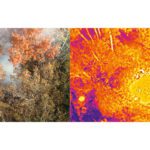
Getting warmer
As climate change leads to larger and more frequent wildfires, researchers at the US Department of Energy's Oak Ridge National Laboratory are using sensors, drones and machine learning to both prevent fires and minimise the damage they cause to the electrical grid. Engineers are honing technology to remotely sense electrical arcing and faulty equipment as well as the direction of spreading fires.
Emissions analyser helps manage power station
A multiparameter emissions monitor at Thetford power station is being used to demonstrate to the Environment Agency that the plant is performing within the...

WHO backs industry stance on airborne threat
The World Health Organisation (WHO) has acknowledged the threat posed by airborne transmission of the coronavirus - a press release from the Building Engineering...

New FOI data shows air quality budgets cut drastically as campaign group calls for...
The budget for local councils to tackle air pollution in their area has been cut by the Government from £225 million a year to...

Intuitive flowmeter
US air sampling technology firm SKC is offering the Chek-mate flowmeter, said to be an easy to use differential pressure flowmeter for calibrating air...

The worm turns for IAQ sensing?
Researchers at the University of Turku in Finland have developed a new method for measuring indoor air quality, making use of fluorescent nematodes.

Measuring movement creates new way to map indoor air pollution
A new way of measuring and analysing indoor air pollution appears - in initial trials - to establish a clear link between office occupancy,...

Instrument test project films images of Earth’s curvature
Physics students from the University of Leicester have captured breathtaking images of the Earth’s stratosphere using a high altitude weather balloon.
The unmanned balloon...

Study explores the lingering threat of “thirdhand smoke” in homes
While the dangers of secondhand smoke are widely recognized, a new study offers detail on a more persistent and stealthier hazard hiding in our...

Community-led science
Residents of Belmont County in eastern Ohio had long suffered from headaches, fatigue, nausea and burning sensations in their throats and noses. They suspected these symptoms were the result of air pollution from fracking facilities that dominate the area and the subsequent investigation offers a powerful example of what can be achieved by citizen scientists.

Call for clarity on DEFRA plan to withhold air quality funding
The Environmental Industries Commission’s Air Quality Taskforce has called for greater clarity on the future of the Air Quality Grant scheme following the news...

Synchronous survey
Routing apps such as Google Maps or Nokia's Here platform could offer a cost-effective way of calculating emission hotspots in real-time, say researchers at the University of Birmingham

New publication asks: Is the UK government’s clean air approach good enough?
Academics and experts at The University of Manchester are calling for large-scale behavioural change in a bid to improve the UK's air quality ("the...

AI-based project provides accurate, real-time, hyper-local air quality data, says group behind it
Exciting possibilities come into view with the capability to gather accurate, real-time air quality data at a hyper-local level, implemented in an affordable way...

Sampler hunts fugitive air pollution
INDUSTRIAL sites and highways could become cleaner in the future thanks to shark-shaped samplers that hunt ‘fugitive’ air pollutants.
Scientists at Lancaster University and the...

Major global cities have seen a surge in air pollution post-lockdown
As the world slowly revolves back to normality, some cities are still benefitting from lockdown-related improvements to air quality, while others are slipping back...

New software models city’s air quality in under 10 minutes
New software can calculate air quality in major cities in under 10 minutes, and within five metres of any given location.
Air pollution monitors are...

Cranfield University selects monitors for DEFRAG project
Air quality technology firm EarthSense says its Zephyr® air quality monitors will be deployed by Cranfield University at various sites across Bedford, Luton and...

Thousands of tonnes of microfibre air pollution could be reduced by changing laundry drying...
A new study appears to reveal that tumble drying a load of laundry releases almost the same amount of potentially harmful microfibres into the...

“Smog-free tower” opens in Rotterdam
The Smog Free Tower uses an electromagnetic field to attract and collect smog particles
BILLED as “the world’s first smog-free tower”, a building in Rotterdam’s...