



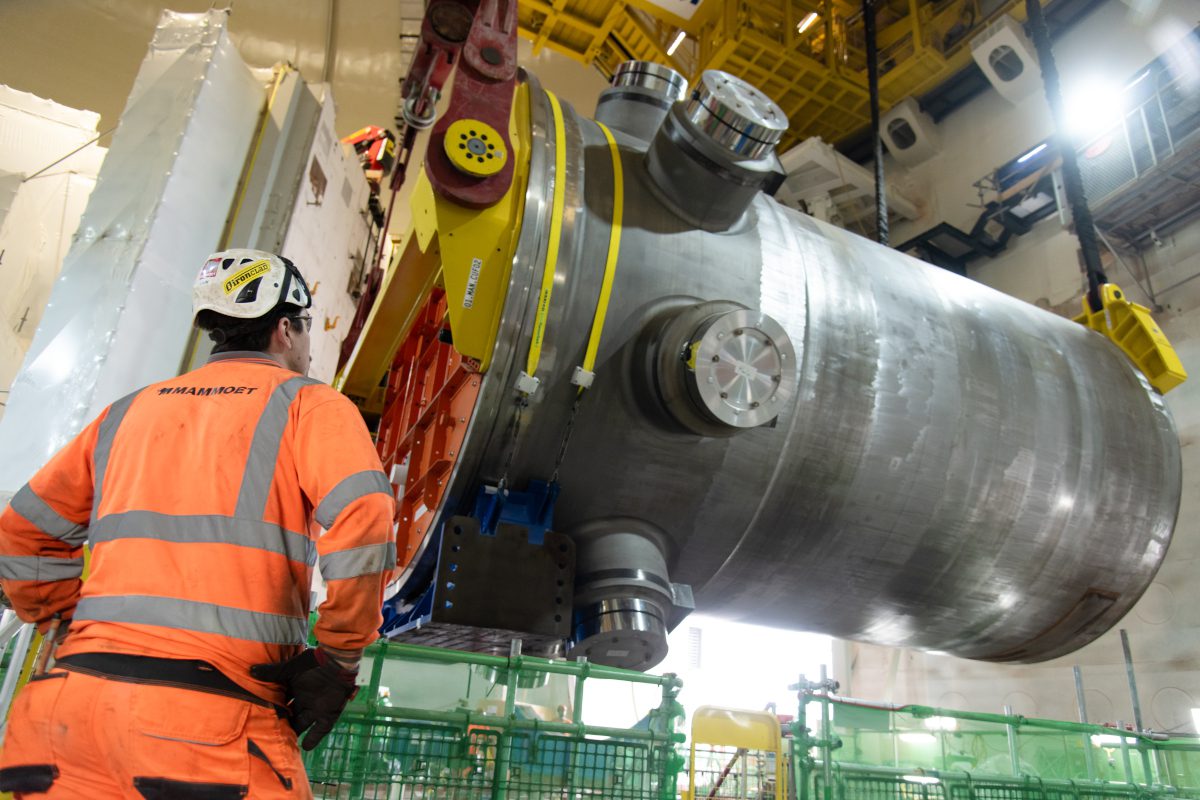
The world’s largest land-based crane1 has lifted the second reactor pressure vessel into place at the Hinkley Point C nuclear power station in Somerset, marking a major milestone in the construction of Britain’s first new nuclear power station in a generation.2, 3
The 500-tonne reactor pressure vessel (RPV) for Unit 2 was hoisted into the reactor building by the Sarens SGC-250 crane, dubbed “Big Carl”, before being handed over to the building’s internal polar crane for final positioning. The vessel was then lowered onto its support ring with a clearance of just 1.7 inches on either side, according to project reports.4
EDF said the installation represents another significant step forward for the project’s second European Pressurised Reactor (EPR), which is being built alongside an identical first unit. Together, the two reactors are expected to generate enough low-carbon electricity to power around six million homes.
The group also said efficiency gains are being made on the project, with lessons learned from constructing the first reactor allowing the second unit to be built between 20 and 30 per cent faster than the first, and reaching a more advanced state of completion at the equivalent stage of construction.
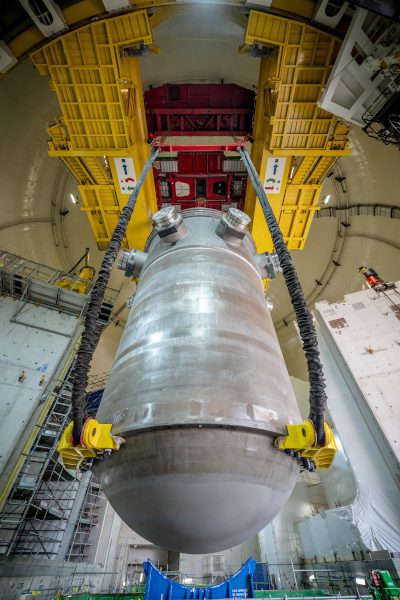
Hinkley Point C Delivery Director Simon Parsons said the project “has taken months of planning and close co-ordination between the 10 main contractors involved.
“We’ve also seen strong innovation to achieve not just a ‘cut and paste’ from the first reactor’s installation, but using our experience to save time, money, and disruption to the site.
“Importantly, we are also applying those lessons to put unit two well ahead of the first unit’s position at the equivalent stage, with more materials in place and more work achieved.”
The reactor pressure vessel is one of the most important components of the nuclear plant. It will eventually contain the reactor core where nuclear fission generates the heat used to produce steam for electricity generation. The vessel was manufactured by Framatome in France and arrived at the Somerset site earlier this year before installation preparations began.6
World Nuclear News reported that, unlike the first reactor vessel, which was installed using a temporary overhead lifting system, the second vessel was lifted into place using Big Carl, a change that project teams say saved space, time and cost.
The latest achievement comes less than a year after Big Carl placed the steel dome on top of the second reactor building, completing the external structure and allowing internal fit-out work to accelerate.7
Rising costs and schedule delays have been reported for the Hinkley Point C project. EDF announced earlier this year that the first reactor is now expected to begin generating electricity in 2030, later than previous forecasts, with project costs continuing to rise.8, 9
EDF and the wider UK nuclear industry regard the project as a critical part of Britain’s long-term energy strategy. Experience gained at Hinkley Point C is also expected to inform construction of the planned Sizewell C nuclear power station in Suffolk, where developers hope to benefit from lessons learned during the Somerset project.
Notes
[1] Heerema’s Sleipnir is widely described as the world’s largest semi-submersible crane vessel, with two 10,000-tonne cranes able to lift 20,000 tonnes in tandem.
[2] “Big Carl lifts Hinkley Point C’s second nuclear reactor into place”, EDF Energy, 1 June 2026.
[3] “In pictures: Second Hinkley Point C reactor vessel installed”, World Nuclear News, 1 June 2026.
[4] “Big Carl lifts Hinkley Point C nuclear power station second reactor into its building”, West Somerset Free Press, 1 June 2026.
[5] “Hinkley Point second reactor unit build 20-30% faster”, Construction Enquirer, 15 October 2024.
[6] “Reactor vessel completed for Hinkley Point C’s second unit”, World Nuclear News, 2 December 2025.
[7] “Big Carl lifts the dome onto Hinkley Point C’s second reactor”, Nuclear Industry Association, 17 July 2025.
[8] “Hinkley Point C nuclear plant delayed to 2030 as costs climb to £35bn”, The Guardian, 20 February 2026.
[9] “EDF pushes back Hinkley Point C start-up by another year”, Financial Times, 20 February 2026.