


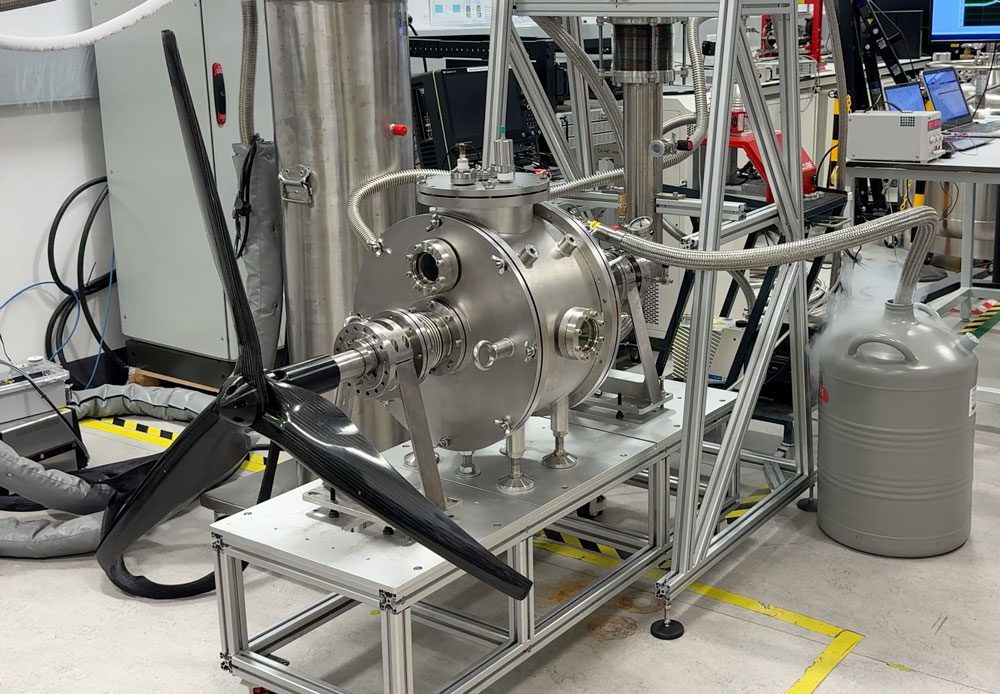
Researchers at the University of Strathclyde have demonstrated a 100kW fully superconducting aviation motor, in what seems a noteworthy advance in the development of future zero-emission aircraft propulsion systems.
The prototype, developed by the University’s Applied Superconductivity Laboratory (ASL) in Glasgow, is believed to be among the first fully superconducting axial-flux motors designed specifically for aviation applications.
The motor uses high-temperature superconducting (HTS) technology, enabling it to carry very large electrical currents with almost no resistance when cooled to cryogenic temperatures of around 20 Kelvin (-253°C). Researchers say the approach could deliver much higher power density than conventional electric motors, a critical requirement for hydrogen-electric and fully electric aircraft.
One of the major challenges facing electric aviation is the need to generate sufficient power without adding excessive weight to aircraft. Superconducting technology has long been viewed as a potential solution because of its ability to deliver lighter and more efficient electrical systems.
Professor Min Zhang, who leads the ASL at Strathclyde, said: “Superconducting technology offers a route to much lighter and more efficient propulsion systems, but it also brings major engineering challenges in cryogenic cooling, protection and system integration.”
Although described as “high temperature”, HTS materials still require cryogenic cooling. Rare-earth barium copper oxide tape, for example, becomes superconducting at temperatures between around 20K and 77K, substantially warmer than conventional superconductors, which generally require cooling to approximately 4K using liquid helium.
The Strathclyde team developed the motor from fundamental research through to a working demonstrator, combining expertise in superconductor physics, cryogenic engineering, electromagnetic modelling and mechanical system integration.
The multidisciplinary project brought together chemists, physicists, electrical engineers and mechanical engineers from across the University and internationally. The researchers designed a fully superconducting motor architecture incorporating low AC loss superconducting windings, brushless excitation technology and rotational cryogenic operation within a single integrated platform.
Professor Zhang said: “This demonstrator shows that fully superconducting aviation motors are no longer just a theoretical concept. By integrating superconducting windings, brushless excitation and cryogenic operation, we have created a platform that can help inform the next generation of megawatt-class propulsion systems.”
The proof-of-concept system forms part of the Aerospace Technology Institute-funded Zero Emissions for Sustainable Transport 1 (ZEST1) programme, led by Airbus. The programme was recognised at the 2025 ATI Aerospace Technology Innovation Awards, where Airbus received the Shaping the Future Award for its work on advancing zero-carbon-emission flight.
Researchers said the demonstrator builds on several years of research carried out through Professor Zhang’s Royal Academy of Engineering Research Fellowship, Fully superconducting machine for zero emission aviation, and the European Research Council Starting Grant, Superconducting Electrical Machines for Zero Emissions.
The team believes the technology represents an important milestone on the path towards future megawatt-class superconducting propulsion systems that could power larger commercial aircraft.
Interest in cryogenic propulsion systems is growing across the aerospace sector, particularly those using liquid hydrogen. Because liquid hydrogen must already be stored at extremely low temperatures, researchers say future aircraft could potentially combine fuel storage, cryogenic cooling and superconducting electrical systems within a single integrated architecture.
Ludovic Ybanex, head of cryogenic electric propulsion system demonstrator at Airbus UpNext, said: “The Airbus UpNext Cryoprop demonstrator is an important step towards the development of future megawatt-class superconducting machines, which would be needed for larger aircraft.”