



 This article contains sponsored content.
As biomethane continues to gain traction as a low-carbon energy source, operators are looking for every opportunity to boost the efficiency and economics of anaerobic digestion plants. This is where judicious choices with the process stages beyond the digester itself can make a big difference. Critical among these are pasteurisation — required for regulatory compliance and pathogen control — and gas conditioning, particularly the removal of hydrogen sulphide to protect infrastructure and meet gas-to-grid specifications.
CSO Group – a UK firm with a background in pollution solutions for energy-from-waste, wastewater treatment and the wider industrial sphere – has introduced technologies designed to address both of these aspects of the process chain. Speaking to the company’s Colin Froud, Envirotec explored its “3VP” pasteurisation turn-key system and G2G biogas desulphurisation system, examining how they function and where they fit within contemporary anaerobic digestion and gas-to-grid operations.
Apart from biogas, digestate is the principal material output from anaerobic digestion, and its use as fertilizer closes an important loop for things like food and agricultural wastes, returning nutrients to the land. But only if the digestate can be deemed safe to use, and in that respect the BSI PAS 110 standard is currently a key requirement for AD operators looking to market digestate as a product. Among other things, it confirms the material is sufficiently free of pathogens.
Heat treatment
A popular way of achieving this is to pasteurise the material at greater than 70°C for 1 hour. CSO provides a turn-key solution for doing this. The material is passed continuously between three identical pasteurisation vessels. At any point in time, you will always have one vessel filling, one being pasteurised (i.e., sitting at 70°C for 1 hour), and one emptying – utilising the cascade principle.
Froud describes this as a “batch” process. It’s “very economical”, he says. “We are very good at recovering the heat back from the pasteurizers, utilising the heat from the pasteurised sludge to preheat the incoming sludge.”
The whole design is built around the Lackeby Heat Exchanger, which the group has been supplying to operators in the sludge sphere for over 20 years. Featuring “world leading heat transfer coefficients”, according to CSO’s website, the Lackeby unit also has a somewhat unique design, including the use of hinged end-plates that facilitate cleaning – sidestepping the fouling problems common to tube-in-tube heat exchangers when handling digestate.
The 3VP system comprises three of these heat exchangers, in conjunction with the three pasteurisation vessels, in addition to pumps, interconnecting pipework and valves, instrumentation and HMI-PLC control. Colin says it occupies a small footprint – another key selling point – and one that can be tailored to the nature of the space.
An effective control mechanism is central to the performance of the system, in Colin’s explanation, which seems to come down to the control philosophy and the HMI-PLC controls. It makes use of instrumentation that picks up on what’s happening in the vessels, including temperature sensors, pressure sensors, flow meters, level sensors and radar display transducers.
H2S removal
While the 3VP system is focused on ensuring digestate quality, elsewhere in an AD plant, another key processing requirement is with the biogas itself. Hydrogen sulphide (H2S) will be present in this gas mixture, and even at relatively low concentrations, it poses a risk to infrastructure and must be removed prior to upgrading and grid injection. CSO helps operators address this with its G2G biogas desulphurisation system.
This is a biological approach to the task. One distinguishing feature is its low oxygen requirement, needing only 0.4% oxygen content “to achieve very effective desulphurisation”. “It’s hard to get biology to work at low O2 concentrations,” as Colin explains, and biological approaches “typically require 2% oxygen in order to operate”. So this is a sizeable deal, especially where the gas is to be injected into the grid, which requires oxygen content below 1%.
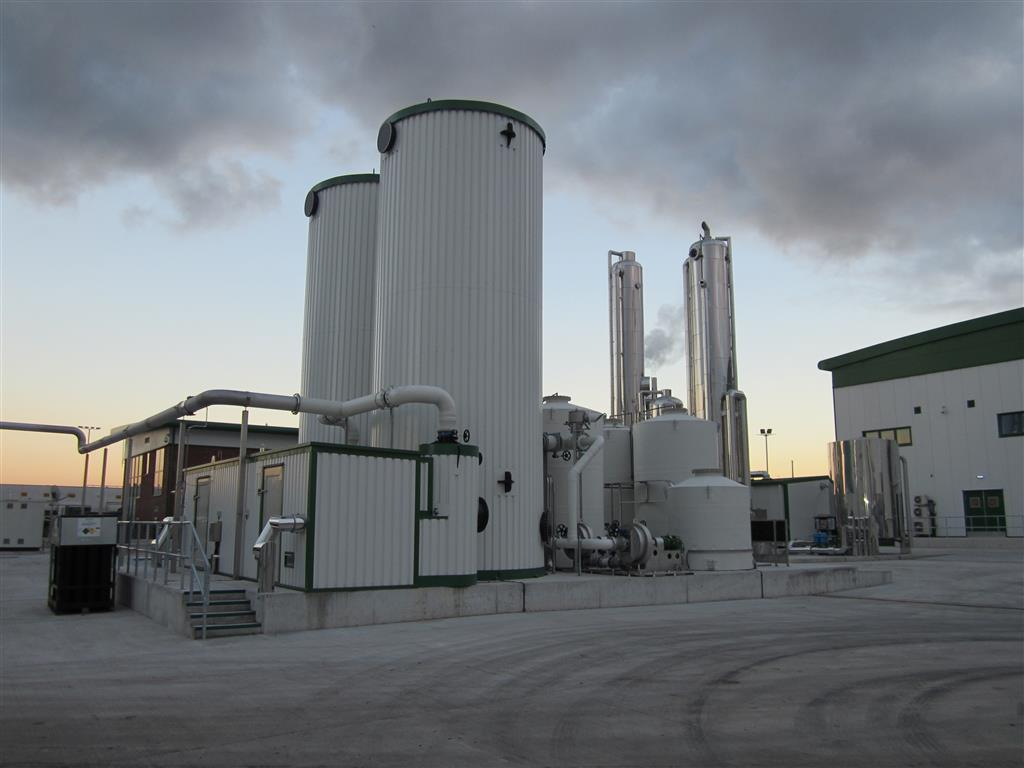
This biogas desulphurisation system will be located between the digester and the CHP or gas upgrading plant. Biogas from the digester is fed into the base of the G2G reactor vessel: a tall, vertical cylinder (potentially 15m high) in which sulphur-oxidising bacteria populate plastic strips inside (suspended from the top of the reactor by a stainless steel grid). Liquid digestate is periodically sprayed at the top of the vessel, providing nutrients for the microorganisms. No enzymes need be added, unlike some other biological approaches.
As biogas travels up through the vessel, the hydrogen sulphide is oxidised to elemental sulphur, which is automatically returned to the digester or digestate storage tank, improving the digestate’s properties as a fertilizer due to the high sulphur content. The approach potentially achieves 99% H2S removal (typical baseline level is quoted as 90%). “Having warm bacteria and sludge is critical to performance,” says Colin, and much of the value CSO adds to this relatively simple and well understood process seems to reside within the control system, and monitoring instrumentation and sensors and SCADA.
No process water is needed, “although a small amount is used to flush the digestate line”, says CSO’s website, and other than what results here, there is no waste effluent. Other headline benefits seem to include: minimal OPEX (irrespective of H2S level), very low energy consumption, and an absence of chemicals.
Both innovations seem examples of interesting work being undertaken beyond the digester, in terms of refining how biogas and other plant products are managed. In a sector where margins, compliance and performance are closely intertwined, these kinds of process innovations might be increasingly significant.