


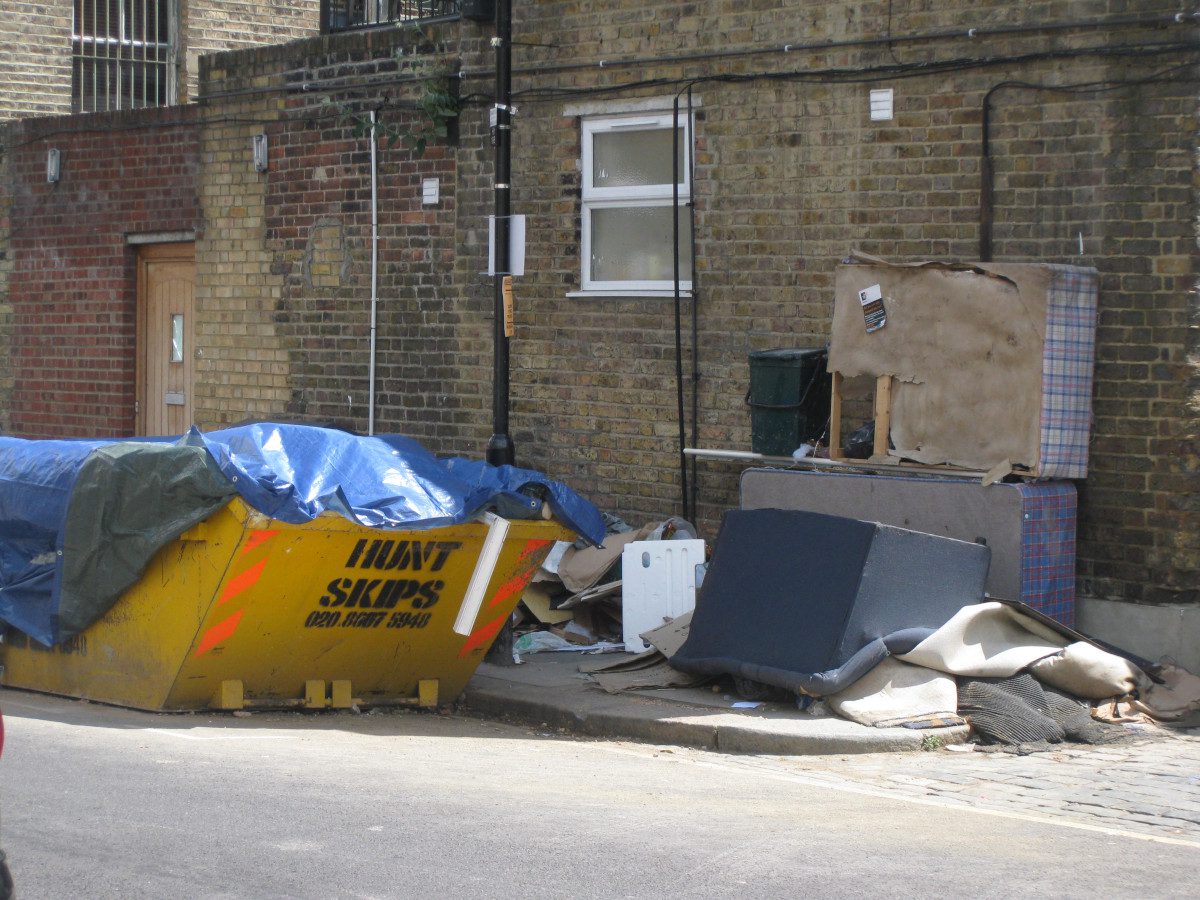
Fly-tipping offenders could be required to clean up dumped waste and contribute towards the cost of putting the damage right under government proposals intended to strengthen local enforcement, as environmental health professionals call for better use of local intelligence to tackle organised waste crime.
A consultation launched by Defra on 20 August proposes giving local authorities powers to issue conditional cautions to people who admit fly-tipping offences. The consultation runs until 16 October.1
Conditional cautions are pre-court sanctions and, under the proposals, could require offenders to undertake up to 20 hours of unpaid clean-up work. Councils could also recover costs associated with cleaning up the waste, potentially providing an alternative to prosecution in suitable cases.2
The government said the measures could allow offenders to be dealt with more quickly without lengthy court proceedings. The consultation is seeking views on issues including how clean-up work should be supervised, implementation costs, potential savings and what should happen if an offender fails to comply fully with the conditions imposed.3
Environment Secretary Dame Angela Eagle said: “If you fly-tip it, you should be the one cleaning it up and paying for it. It’s that simple.
“Fly-tippers show a blatant disregard for our communities, leaving residents to live with the mess they create.
“I want to give councils new powers to make offenders take responsibility for their actions, by helping to clear up the communities they have harmed and covering the cost of putting things right.”4
The proposals coincide with an apparent expansion of enforcement activity against waste crime. The government has announced a Waste Crime Crackdown Group which it says brings together government, regulators, police, local government and Mayors, with a greater role for the police and National Crime Agency and additional Environment Agency officers deployed to tackle the problem.5
In July, the government announced that the maximum on-the-spot fine for fly-tipping would increase from £1,000 to £5,000. Councils have also received guidance on identifying, seizing and disposing of vehicles used for fly-tipping.6
Local intelligence
The Chartered Institute of Environmental Health (CIEH) welcomed the prospect of additional enforcement tools but said the wider crackdown would depend on making effective use of intelligence gathered locally by Environmental Health Practitioners (EHPs).7
Its intervention follows the government’s announcement of region-led approaches beginning in West Yorkshire and Greater Manchester. The arrangements are intended to bring councils, police, regulators and other enforcement bodies together, with Mayors leading efforts in their areas and improved intelligence and capability sharing at local level.8
CIEH argues that apparently isolated local problems can provide early indications of larger criminal operations. Reports of unusual vehicle movements, smoke, odours, pests, illegally stored materials and repeated dumping, for example, can potentially be combined to identify activity extending across local authority boundaries.9
Ian Andrews, Head of Environmental Health at CIEH, said: “Organised waste crime may operate nationally, but it leaves evidence locally. Environmental Health professionals know their communities and understand what normal activity looks like in their areas. That enables them to recognise warning signs, connect apparently separate incidents and help build the intelligence picture needed to expose criminal activity.
“They also understand the consequences for people. Waste crime is not simply about rubbish being left in the wrong place. It can cause fires, pollution, pests, toxic fumes and exposure to hazardous materials, damaging people’s health as well as the places in which they live and work.”10
The government has placed greater emphasis on intelligence and coordination in its recent approach to organised waste crime. Its Waste Crime Action Plan, published earlier this year, includes measures intended to improve data and intelligence sharing, strengthen regulation and enforcement and introduce digital waste tracking. It also envisages greater use of technologies including drones to help identify and investigate illegal waste activity.11
On 19 August, the government said West Yorkshire and Greater Manchester would be the first areas to adopt the new region-led approach, while Environment Agency Chief Executive Philip Duffy said strengthening intelligence and analysis and working more closely with regional partners would help the agency “stay well ahead of the criminals behind this activity”.12
Partnership approach
CIEH points to the Lincolnshire Environmental Crime Partnership as an example of how local intelligence can feed into coordinated enforcement.13
The partnership was established after agencies in the county identified a need for a dedicated approach to fly-tipping and waste crime. Its first meeting brought together all of Lincolnshire’s district councils, the county council, police, NFU, Country Land and Business Association, Ministry of Defence and Internal Drainage Board. Its membership subsequently expanded to include organisations such as the DVSA, Forestry Commission and National Trust.14
The partnership developed a Waste Crime Partnership Information Sharing Agreement to provide a framework for agencies to exchange information, as well as arrangements for coordinated vehicle seizures and intelligence-led interventions.15
The approach has resulted in practical enforcement operations. During Operation Clean Sweep in March 2025, roadside inspections and site visits in Boston and Skegness found five vehicles carrying waste unlawfully, resulted in three vehicle seizures and identified a previously unknown illegal waste site. Multiple fines were also issued.16
Andrews said: “Greater involvement from the National Crime Agency, police and Environment Agency is welcome. But those organisations need strong intelligence from the ground. Without sufficient local capacity, opportunities to intervene early will be missed and national agencies may only see the problem once an illegal site has become established.”17
CIEH says it wants Environmental Health expertise embedded in the Waste Crime Crackdown Group and regional partnerships, and argues that councils will require sufficient trained staff and enforcement capacity if the new measures are to be effective.18
Rising caseload
The proposals arrive against a backdrop of rising recorded fly-tipping in England. Local authorities dealt with 1.26 million incidents during 2024/25, 9% more than the 1.15 million recorded the previous year. Household waste was involved in 62% of incidents, while 52,000 incidents were equivalent to a tipper-lorry load or larger. Clearing these larger incidents alone cost councils £19.3 million.19
Councils carried out 572,000 enforcement actions during the year, an increase of 8%, including 386,000 investigations and 69,000 fixed penalty notices.20
Prosecution was considerably less common. There were 1,377 prosecution actions in 2024/25, down 14% from the previous year, although 99.1% resulted in successful prosecutions. The majority of prosecution outcomes were fines.21
Defra’s statistics cover incidents reported by local authorities and exclude large-scale incidents dealt with by the Environment Agency as well as the majority of incidents on private land. The department also cautions that changes in reported fly-tipping numbers can partly reflect differences in how proactively authorities identify and record incidents, rather than changes in offending alone.22
The conditional-caution consultation asks councils and other interested parties to consider how the proposed system might affect prosecution rates and whether alternative measures could prove more effective in deterring fly-tipping.[23]
Notes
[1] Department for Environment, Food & Rural Affairs (Defra), Consultation on powers for local authorities to issue conditional cautions to fly-tipping offenders, 20 August 2026.; [2] Defra, Fly-tippers forced to pay up for the streets they trashed, 20 August 2026.; [3] Defra, Consultation on powers for local authorities to issue conditional cautions to fly-tipping offenders, op. cit.; [4] Defra, Fly-tippers forced to pay up for the streets they trashed, op. cit.; [5] Prime Minister’s Office, 10 Downing Street, Prime Minister orders crackdown on the criminal gangs profiting from illegal waste and blighting communities, 19 August 2026.; [6] Defra, War on waste crime: hefty new fines for fly-tippers and litter louts, 15 July 2026.; [7] Chartered Institute of Environmental Health (CIEH), Waste crime crackdown will depend on local Environmental Health intelligence, says CIEH, press release, received 20 August 2026.; [8] Prime Minister’s Office, Prime Minister orders crackdown on the criminal gangs profiting from illegal waste and blighting communities, op. cit.; [9] CIEH, Waste crime crackdown will depend on local Environmental Health intelligence, says CIEH, op. cit.; [10] Ibid.; [11] Defra, Waste Crime Action Plan, March 2026.; [12] Prime Minister’s Office, Prime Minister orders crackdown on the criminal gangs profiting from illegal waste and blighting communities, op. cit.; [13] CIEH, Waste crime crackdown will depend on local Environmental Health intelligence, says CIEH, op. cit.; [14] Environment Agency, Creating an effective waste crime partnership, 6 September 2023.; [15] Ibid.; [16] Environment Agency, Defra and British Transport Police Authority, Operation Clean Sweep tackles waste crime in Lincolnshire, 11 March 2025.; [17] CIEH, Waste crime crackdown will depend on local Environmental Health intelligence, says CIEH, op. cit.; [18] Ibid.; [19] Defra, Fly-tipping statistics for England, 2024 to 2025, updated 25 February 2026.; [20] Ibid.; [21] Ibid.; [22] Ibid.; [23] Defra, Consultation on powers for local authorities to issue conditional cautions to fly-tipping offenders, op. cit.