



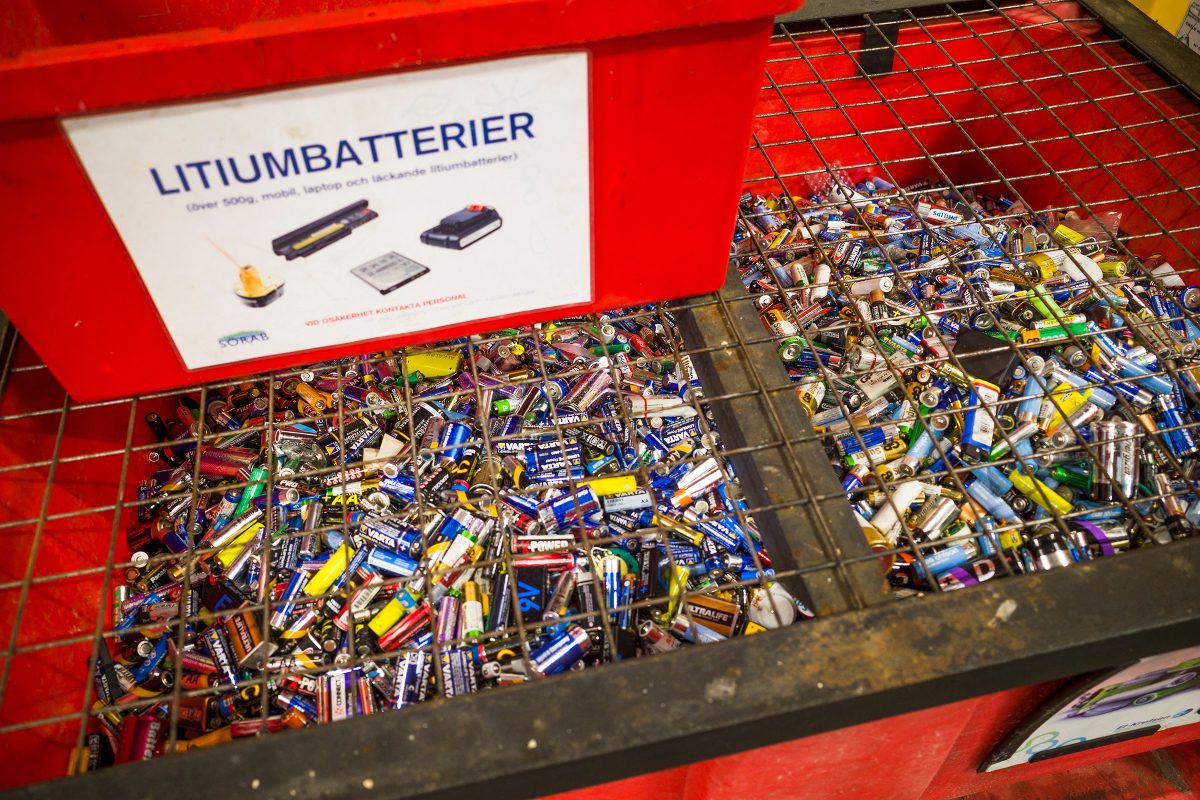
The latest EU-wide portable battery collection rate stands at 48.8%, while the Batteries Regulation sets a 63% target for the end of 2027. But a change in the calculation method – and the growing share of longer-lived lithium-ion batteries – complicates the comparison.
The EU collected 48.8% of its waste portable batteries in 2023, according to Eurostat. The figure cleared the 45% minimum under the Batteries Directive methodology then used for reporting, but stands 14.2 percentage points short of the 63% target set for the end of 2027 – although the calculation method applying to the new target differs from that used for the 2023 figure.
An analysis by German company SOMUVA UG (haftungsbeschränkt) compares the latest official figures for the EU, Germany and the UK, and highlights how changes in battery use and in the calculation methodology could affect reported collection rates.
Three targets, two formulas
Regulation (EU) 2023/1542 requires producers of portable batteries, or the producer responsibility organisations acting for them, to reach collection rates of 45% by 31 December 2023, 63% by 31 December 2027 and 73% by 31 December 2030, under Article 59(3). The relevant provisions in Chapter VIII have applied since 18 August 2025. The targets bind producers and their organisations, while Annex XI provides for Member States to calculate national collection rates using the same methodology.
Annex XI divides the weight of waste portable batteries collected in a calendar year by the average weight made available to end-users in the three preceding years.
The former Batteries Directive 2006/66/EC used a different average in its Annex I: the reporting year and the two years preceding it. Eurostat’s figures up to 2023 were compiled under the Directive methodology.
The distinction can affect the resulting collection rate. Where sales are rising, leaving the latest year out of the average lowers the denominator, so the same collected tonnage produces a higher rate. Where sales are falling, the effect is reversed.
Where countries stood in 2023
Eurostat’s dataset env_waspb, last updated on 27 November 2025, runs to reference year 2023. The EU value of 48.8% is marked as imputed. Romania and Sweden have no 2023 values; for EU aggregates, Eurostat estimates missing countries using the previous year’s data.
Of the 25 Member States reporting 2023 data, only Poland, at 64.9%, recorded a rate above the 63% level subsequently set for 2027. This was up sharply from 44.1% in 2022.
Sixteen countries recorded rates between 45% and 63%. Belgium (60.3%), Luxembourg (57.8%), Croatia (57.5%) and France (54.5%) were among the closest to the 2027 level, while Germany reported 50.4%.
Eight countries were below 45%: Cyprus (40.2%), Slovenia (39.7%), Spain (38.9%), Hungary (36.1%), Greece (35.9%), Italy (35.5%), Malta (24.5%) and Portugal (22.5%).
Outside the EU, Norway reported 63.6% for 2023. Eurostat also lists Northern Ireland separately, at 45.9%.
These figures provide an indication of the scale of the increase required in collection performance, although direct comparisons with the 2027 target need to take account of the change in calculation methodology.
Germany: 2024 data illustrate the effect of the change
For 2024, the German Federal Environment Agency (UBA) reports a collection rate of 53.8%, based on 31,898 tonnes collected and 59,496 tonnes placed on the market.
That figure follows the Directive methodology, using 2022 to 2024 as the reference years. Applying the Annex XI methodology to the same UBA data series, using 2021 to 2023 instead, produces a rate of 52.7%, according to SOMUVA’s calculation.
In this case the newer methodology produces a slightly lower rate because German sales were higher in 2021 than in 2024. The example illustrates how the choice of reference years can alter the reported rate even when the quantity of waste batteries collected remains unchanged.
UK remains close to the 45% line
The UK, meanwhile, retains a portable battery collection target of 45%, including for 2026.
According to Environment Agency National Packaging Waste Database figures, the UK achieved a collection rate of 45.13% in 2025, following 44.93% in 2024 – when the target was narrowly missed – and 45.50% in 2023.
As under the former EU Directive, the UK calculation uses an average covering the reporting year and the two preceding years. For 2025, the database records 47,560 tonnes placed on the market, a three-year average of 44,676 tonnes and 20,210 tonnes collected. The published collection rate is based on 20,160 tonnes covered by accepted evidence notes.
SOMUVA’s calculation from the 2025 tables also reveals a striking difference between the composition of batteries placed on the market and those collected. Lead-acid batteries accounted for just 3.4% of the tonnage placed on the market but 50.1% of the tonnage collected.
The “Other” category – covering batteries that are neither lead-acid nor nickel-cadmium – accounted for 96.4% of the market by weight but 46.0% of collections.
The disparity also illustrates how a tonnage-based collection rate can be heavily influenced by the types of batteries entering the waste stream, rather than simply reflecting the number of batteries returned.
Growing lithium-ion share complicates the picture
The UK tables do not separately identify lithium-ion batteries, but German data provide an indication of their growing importance.
UBA data files show that 17,914 tonnes of rechargeable lithium-ion portable batteries were placed on the German market in 2024, accounting for about 30% of all portable batteries. In 2015 the corresponding figure was 6,927 tonnes.
The growing share of rechargeable batteries presents a potential difficulty for a collection rate based on recent sales. Batteries sold during the reference period are included in the denominator even when they remain in use and are not yet available to enter the waste stream.
The EU legislation anticipates this problem. Article 59(7) of the Batteries Regulation refers to the “increase of the expected lifetime of rechargeable portable batteries” and to the objective of better determining “the actual volume of waste portable batteries available for collection”.
It empowers the European Commission to amend the Annex XI methodology and the collection target by 18 August 2027, while “maintaining equivalent ambition and timelines”. Recital 108 also says the review could consider separate collection rates for rechargeable and non-rechargeable portable batteries.
The consolidated text of the Regulation as of 13 August 2026 shows no amendment to Article 59 or Annex XI. For now, therefore, the 63% target due at the end of 2027 remains a sales-based measure – but the methodology used to judge collection performance may itself become part of the battery collection debate.