



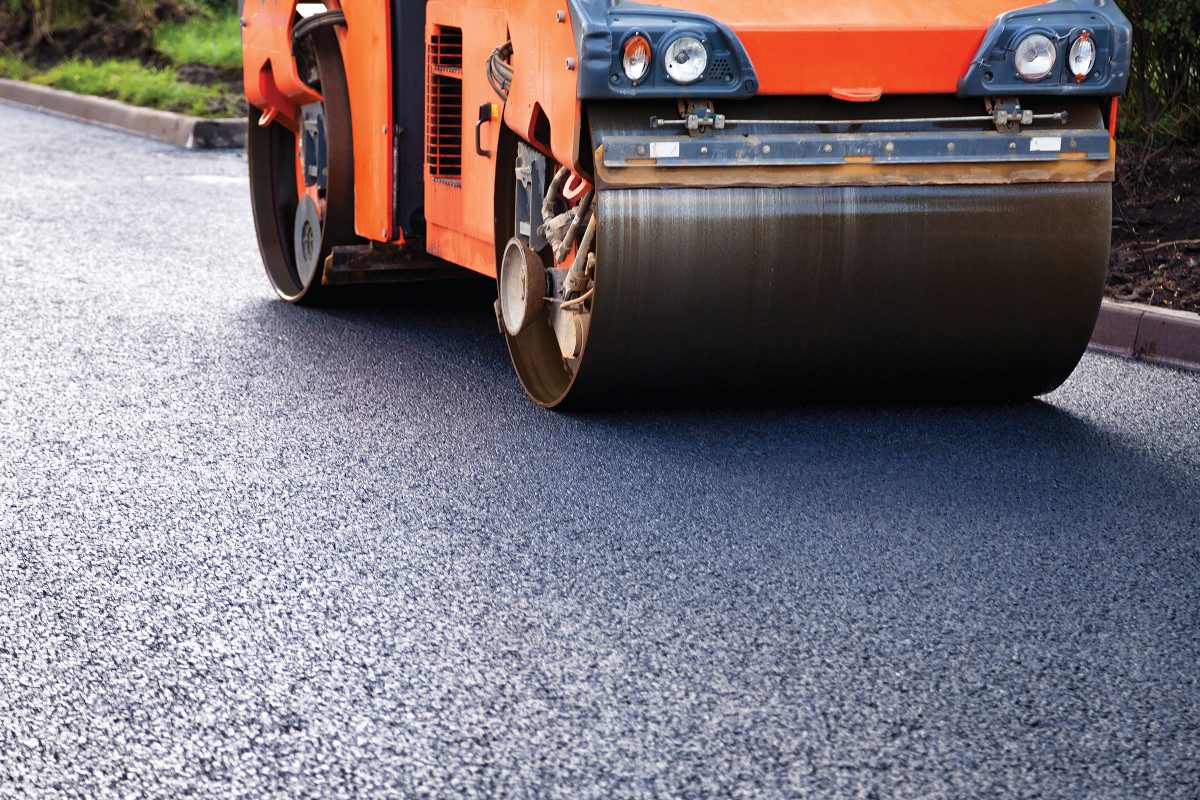
Adding recycled plastic to asphalt could improve road durability without increasing the release of microplastic-like particles, according to new research from Pennsylvania State University. The findings might help alleviate concerns about the environmental consequences of incorporating plastic waste into road surfaces, although researchers caution that further testing is needed.
The study, published in the Journal of Cleaner Production, examined asphalt modified with recycled low-density polyethylene (LDPE), a plastic commonly used in packaging. Laboratory tests found that the modified material maintained greater structural integrity than conventional asphalt when subjected to simulated traffic loading, heat and moisture.
Significantly, the researchers also recorded a lower measured level of particles resembling LDPE released from the modified asphalt. Their findings suggest that improving the durability of road surfaces could help reduce particle pollution, potentially offsetting some of the environmental risks associated with introducing plastic into pavement materials.
The research addresses an important uncertainty surrounding plastic-modified asphalt, which has attracted interest as a means of diverting waste from landfill while improving road performance.
“Our goal was to understand whether asphalt pavement containing recycled plastic could release microplastic particles as it is damaged over time,” said Shihui Shen, distinguished professor of rail transportation engineering at Penn State Altoona and corresponding author of the study.
“That environmental question has received much less attention than the engineering performance of the pavement.”
Simulating road deterioration
The researchers prepared asphalt samples incorporating shredded LDPE, crushed stone and reclaimed asphalt pavement, together with a conventional binder. These were compared with unmodified asphalt using two established laboratory testing procedures.
The Hamburg Wheel Tracking Test subjected specimens submerged in hot water to repeated loading from steel wheels, simulating the combined effects of traffic, heat and moisture.
A second procedure, the Moisture-Induced Stress Tester, exposed samples to elevated temperatures, moisture and repeated hydrostatic water pressure.
Particles released during testing were collected and analysed using laser direct infrared imaging, which enabled researchers to examine their chemical signatures and identify those resembling LDPE.
The modified asphalt generally performed better in the durability tests. Following combined high-temperature and moisture conditioning, it also exhibited an apparent normalized particle area — a measure based on the detected area of LDPE-like particles relative to sample mass — 56.5% lower than that of conventional asphalt.
This result is not equivalent to a 56.5% reduction in total microplastic emissions, but suggests that the improved structural integrity of the modified material could reduce the release of potentially plastic-containing debris.
Questions over particle identification
One difficulty encountered by the researchers was distinguishing plastic particles from substances already present in conventional asphalt.
Asphalt binder and LDPE share some infrared characteristics, making it difficult to establish whether detected particles originated from added plastic or the asphalt itself.
The team therefore characterised the original materials before analysing released particles, allowing comparisons between their chemical signatures.
“Asphalt binder and LDPE share some infrared features, which can complicate both identifying particles as plastic and determining their source,” Shen explained.
“The findings do not rule out the possibility that either plastic-modified or unmodified asphalt mixtures can release microplastics.”
The study also emphasised the importance of contamination controls during testing. Equipment was cleaned, background measurements were taken and filtered water and glass containers were used where possible to minimise the risk of introducing extraneous plastic particles.
Further evidence needed
The findings provide preliminary support for using recycled plastic in road construction, but the researchers stress that the experiments involved only one asphalt formulation and one source and quantity of recycled plastic.
Consequently, the results cannot yet be generalised to other mixtures or to roads exposed to years of traffic and weathering.
Field studies will need to examine the effects of traffic volumes, rainfall, temperature fluctuations, sunlight and pavement ageing, alongside the potential movement of particles into roadside soils and stormwater.
Such work will be important in determining whether the engineering benefits of plastic-modified asphalt translate into measurable environmental advantages over its service life.
“Field studies, reliable sampling and long-term monitoring will give transportation agencies stronger evidence for weighing pavement-performance benefits against potential environmental impacts,” said Shen.
The researchers also call for more standardised methods of measuring microplastic releases from road construction materials, enabling more reliable comparisons between conventional and plastic-modified asphalt.
Notes
[1] Penn State University, “Recycled plastic asphalt may boost pavement performance, limit particle release”, 13 October 2026.
[2] Liu, Z., Nyoni, H., Mina, O. and Shen, S., “Microplastics release from recycled plastic modified asphalt: Detection, characterization, and environmental implications”, Journal of Cleaner Production, Volume 577, 2026.