



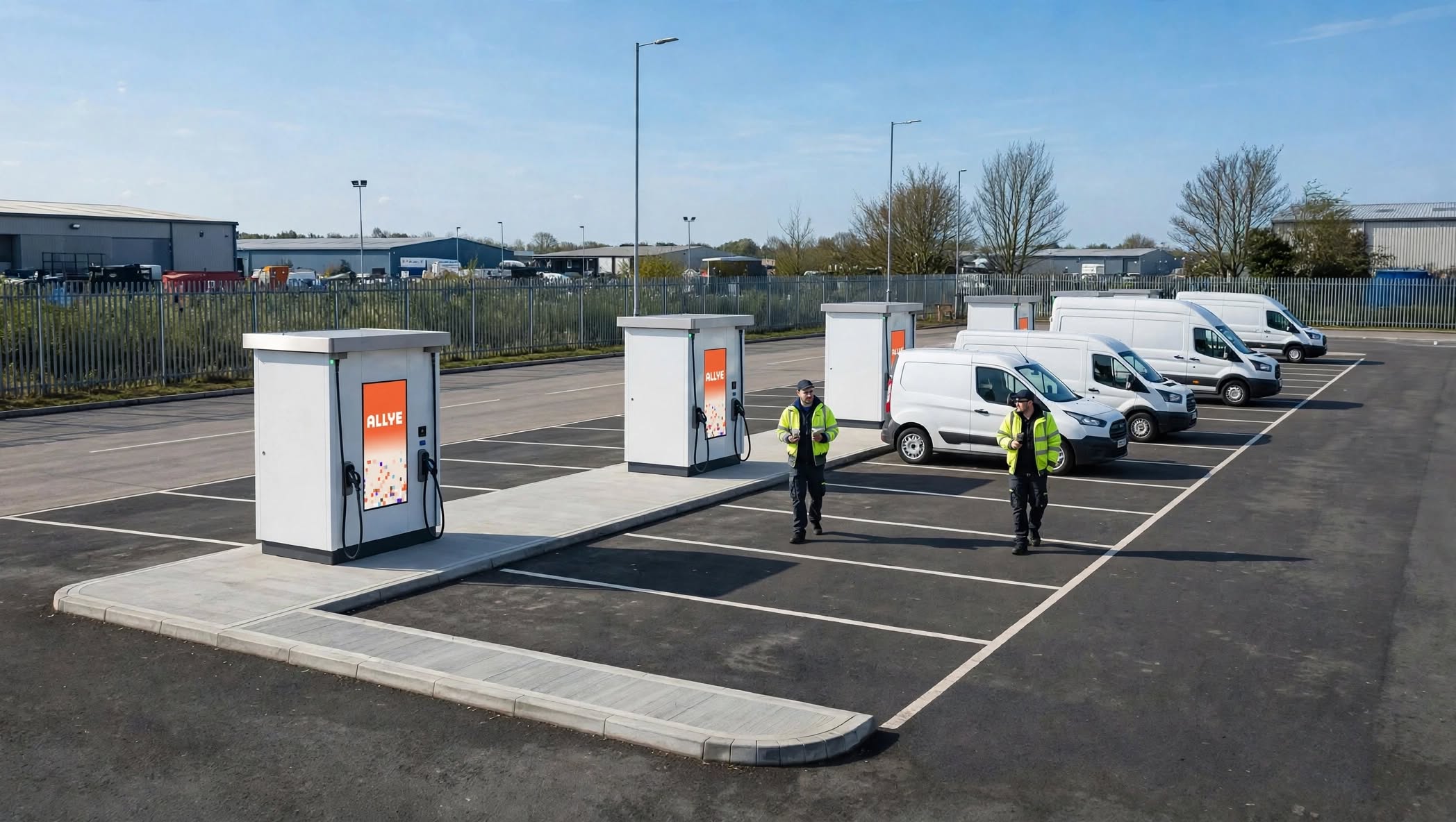
A new ultra-rapid electric vehicle charger uses repurposed EV batteries to overcome grid capacity constraints, potentially allowing fleet operators to install high-power charging infrastructure without costly electricity network upgrades.
Developed by UK clean-tech company Allye Energy, the MEV system combines battery storage with DC charging equipment capable of delivering up to 400 kW to two vehicles simultaneously. By accumulating electricity from an existing low-capacity connection, the system can supply vehicles with considerably more power than the grid connection could provide directly.
Launched on 27 October, the technology is aimed at fleet depots and public charging sites where insufficient grid capacity can delay electrification projects or make them prohibitively expensive.
The system will be available in two versions, the MEV200 and MEV300, offering 155 kWh and 232 kWh of storage respectively. Prices start at £70,000, with deliveries expected in the second quarter of 2027.
Reusing vehicle batteries
Unlike conventional battery-buffered charging systems, the MEV uses whole battery packs recovered from electric vehicles, giving them a second life in stationary energy storage.
Allye’s PackFlex technology allows batteries of different sizes, ages and chemistries to operate together, with independent battery management and power control for each pack. An 800V architecture supports charging for both 400V and 800V vehicles.
The company estimates that using repurposed batteries avoids between 15 and 24 tonnes of CO₂-equivalent emissions per unit compared with manufacturing new battery cells.
Although the charger can deliver up to 400 kW, the duration of high-power charging depends on the energy stored in its batteries and the rate at which electricity can be replenished from the grid.
The modular design also allows individual battery packs to be removed for maintenance without taking the entire system out of service.
Proven at Glasgow depot
The new product builds on Allye’s existing MAX300 battery storage technology, which has already been deployed in applications including commercial vehicle charging.
At J&M Murdoch’s refuse depot in Glasgow, Allye and charging specialist Chargepoly installed a battery-buffered system after a grid connection upgrade was reportedly quoted at £300,000.
The installation uses the depot’s existing 22 kW supply to charge a MAX300 storage system, which feeds a satellite DC fast charger serving two electric vehicles. According to Allye, the arrangement supplies approximately 200 kWh of electricity daily.
The company says more than 20 MAX systems incorporating over 100 repurposed EV batteries are already operating, including installations for JLR and Roadchef.
Avoiding grid upgrades
Battery-buffered charging could offer an alternative to upgrading electricity connections at sites where vehicles spend long periods parked but require relatively rapid charging between shifts.
Allye says the MEV can be connected to existing electrical supplies and commissioned within hours of delivery, with the option to relocate the equipment if a depot moves.
The company also claims that reduced network capacity charges, off-peak electricity purchasing and participation in grid services could offset the higher initial cost of battery-buffered equipment.
The MEV200 is available through a charging-as-a-service arrangement starting at £1,900 per month, providing an alternative to outright purchase.
The launch comes ahead of the second round of the Government’s Depot Charging Scheme, which is intended to support the development of charging infrastructure for commercial vehicle fleets.