


Printed advertising boards for buses are traditionally used two or three times, with limited scope for recycling into equivalent products. A new system from plastics manufacturer Corplex is said to reduce their carbon footprint by up to 80%, enabling the material to be recovered and returned to new boards in a closed-loop recycling process. Described as the first scalable mechanical deinking process for printed polypropylene signage, the approach was recognised with a win in the Circular Economy Initiative category at last year’s National Recycling Awards.1
Printed advertising is an everyday sight on buses and billboards, yet the materials used can present challenges for recycling. Traditionally, bus signage uses printed vinyl glued onto Correx® polypropylene sheets, limiting reuse. Although paper-based alternatives exist, they may be less suitable for the demands of public transport environments and changing weather conditions.
Corplex, a European manufacturer of polypropylene sheets, has been exploring ways to prolong the life cycle of plastic products through reuse and recycling. With substantial quantities of plastic waste in the European Union still ending up in landfill or incineration,2 there is a need for scalable closed-loop solutions.
Working with a creative agency and printing partner, Corplex set out to develop a recyclable, weather-resistant bus advertising solution that maintains print quality.
From linear to circular
Advertising campaigns are frequently changed, meaning that plastic panels are in regular rotation. In the traditional ‘linear’ model, a vinyl sticker displaying the advertisement is printed and applied to a Correx® board. Once the campaign ends, the vinyl is stripped and sent to landfill or incineration, while the board may be reused two or three times before being recycled into lower-grade material.
Corplex’s approach removes glued vinyl altogether, instead printing directly onto mono-material Correx® boards. Corplex is the original manufacturer of Correx®, a widely used fluted polypropylene sheet. In the new process, used sheets are shredded into flakes and the ink is washed off without substantially degrading the plastic. The resulting white chips are then used to manufacture new advertising boards, enabling closed-loop recycling.
Environmental and operational gains
Corplex says the process offers environmental and operational advantages over conventional signage production, particularly by reducing the need for virgin material and eliminating the separate vinyl layer. The group cites the following wins:
• Up to 70% recycled material can be incorporated into new boards, compared with 20% previously, according to the company.
• Corplex says the material can undergo more than ten cycles of use and reprocessing, reducing demand for virgin polypropylene.
• An assessment by Carbon Quota indicates an 80% reduction in carbon footprint, with estimated savings of more than 3,000 tonnes of CO₂ annually.
Eliminating vinyl application and removal also reduces processing time, waste and cost. Corplex uses a water filtration and reuse system which it says eliminates wastewater discharge. The cleaning process uses a mild detergent.
A world first
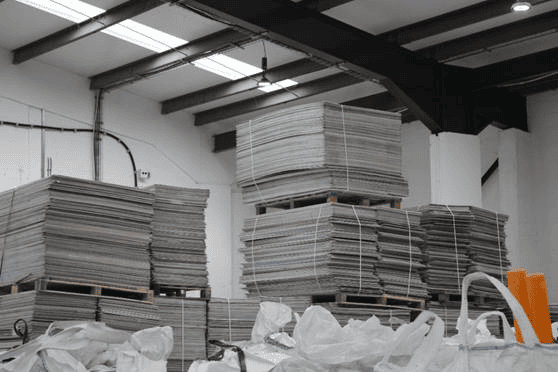
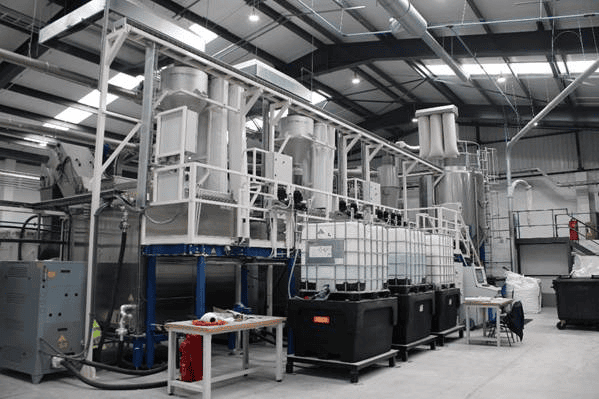
At its 22,000 sq ft deinking facility in Gloucester, Corplex operates a granulation and deinking production line to shred and clean the advertising sheets. Energy data is collected using Siemens SENTRON measuring devices, with PAC3220 meters installed at process-line level to monitor energy consumption, voltage, current, power factor and frequency.
“When we first explored the idea of creating a closed-loop solution for Correx®, it felt almost experimental”, says Tabitha Clark, Market Director, Construction, Steel & Manufacturing at Corplex.
“That initial concept has evolved into a fully operational, first-of-its-kind system. What makes it so powerful is that we’re not just recycling material. We’re restoring it to a quality that allows up to 70% of it to go straight back into the same product. That’s genuinely circular. The process itself is also impressive. It’s simple in principle, but the engineering behind it is pioneering, especially for such a heavy substrate.”
The company is now exploring applications beyond outdoor advertising, including retail and pharmaceuticals.
“What’s particularly exciting is that this innovation goes far beyond outdoor advertising. We’re now engaging with customers across sectors such as retail and pharmaceuticals, exploring how this technology can support their sustainability ambitions,” says Clark.
The project was supported by a £3.15 million equipment financing arrangement involving Eurolease and Siemens Financial Services (SFS). Eurolease introduced Corplex to SFS, which financed the production line through a sale and hire-purchase-back arrangement.
The financing enabled Corplex to acquire the equipment while retaining capital for other investments.
Corplex’s mechanical deinking system offers a potential model for recycling printed polypropylene products into material suitable for the same application, rather than directing recovered plastic into lower-grade uses.
Notes
[1] Eye on Display, Corplex wins at the MRW National Recycling Awards for its closed-loop recycling system, 26 November 2025
[2] European Commission, Questions & Answers: A European strategy for plastics, January 2018