A methane recovery technology recently trialled at an Anglian Water wastewater treatment site has demonstrated the potential to reduce greenhouse gas emissions while recovering additional biogas from sewage sludge – specifically, the portion that conventional treatment systems overlook.
UK firm Bluemethane tested its Chloe technology at the utility’s Cotton Valley facility, where it was installed downstream of anaerobic digestion to capture methane remaining in treated sludge. The results were published on 2 November by water innovation organisation Imagine H2O, which supported the project through its Water Innovation Pilot Fund.1
The trial at Cotton Valley, where sludge undergoes thermal hydrolysis pretreatment before anaerobic digestion, followed an earlier trial at Thames Water’s East Hyde site, which uses conventional anaerobic digestion.
Over 228 operating hours, the system at Cotton Valley processed 460m³ of post-digested sludge and captured 58% of the methane measured in the treated stream. It recovered 1.37m³ of biogas for every kilowatt-hour of electricity consumed, “demonstrating a positive energy balance”, according to Imagine H2O.
The organisation estimates that year-round operation could prevent emissions equivalent to approximately 590 tonnes of carbon dioxide annually, while recovering biogas capable of providing around 100MWh of energy. These figures are projections based on the pilot, rather than savings demonstrated over a full year.
How it works
Anaerobic digestion is widely used at wastewater treatment works to stabilise sewage sludge and produce biogas, which can be used to generate energy. However, some methane remains dissolved or entrained in the digested material and may subsequently escape during storage and handling.
The Chloe technology is designed to recover this residual methane before it is released. Its modular system uses controlled pressure variation, turbulence and gravity-driven separation to extract gas from the sludge stream. The recovered gas can be directed into existing CHP or biomethane infrastructure2
The Cotton Valley installation was designed to operate alongside existing sludge treatment processes, without requiring substantial changes to the site’s infrastructure.
David Inman, Innovation Projects Manager at Anglian Water, said:
“Methane that stays in digested sludge doesn’t stay put. It escapes further downstream, from storage tanks and beyond, ultimately being emitted to the atmosphere. As a UK wastewater sector, we have to deal with it, and ideally recover it rather than burn it. That’s why we hosted Bluemethane’s methane capture technology at Anglian Water’s sewage treatment centre.
“Bluemethane’s technology did what the company said it would. Over four months, the system pulled methane-rich biogas out of our digested sludge safely and reliably. It sat downstream of anaerobic digestion, and we didn’t have to change how we run the site.
“We need technologies like this, and partners like Bluemethane and Imagine H2O to deliver them.”
Anglian Water has committed to achieving net-zero operational emissions by 2030. Wastewater treatment accounts for around one-third of its emissions, according to figures cited by Imagine H2O from the company’s climate transition plan.
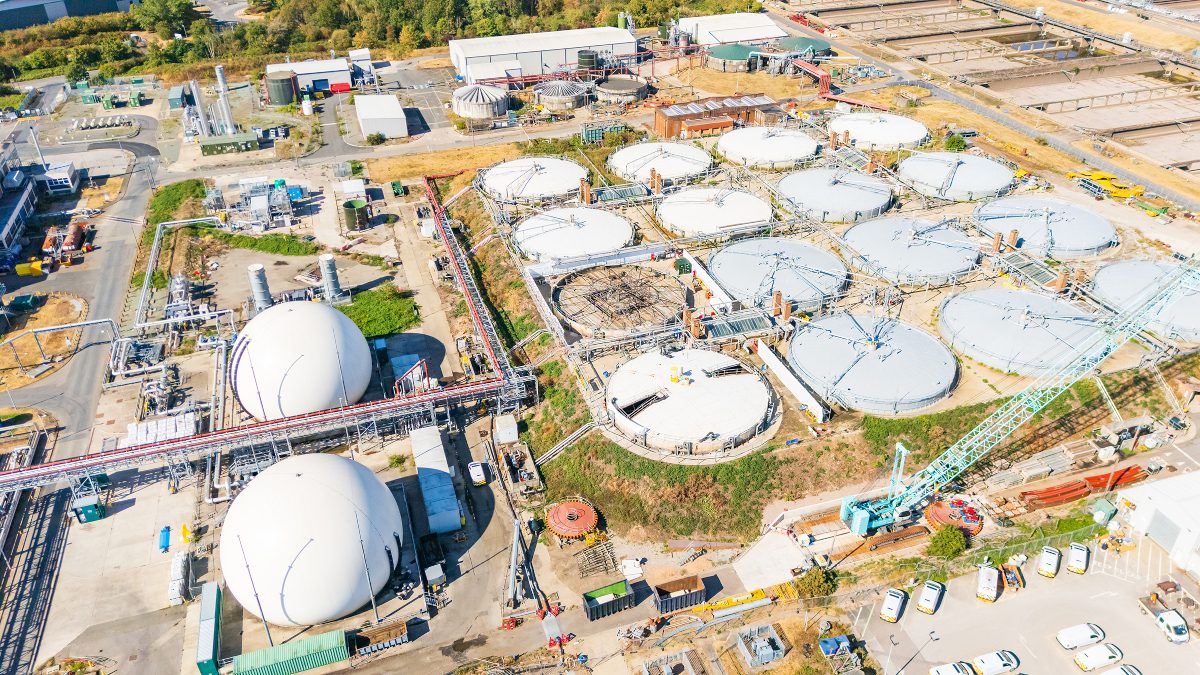
Bluemethane says the two deployments conducted thus far have demonstrated its suitability for different sludge treatment processes.
Results to be presented at the 2026 European Biosolids & Bioresources Conference indicate that recovered gas at Cotton Valley contained approximately 60–65% methane, with recovered energy reaching up to six times the system’s energy demand under trial conditions.3
Notes
[1] Imagine H2O (2 November 2026), “How Bluemethane Is Rethinking Wastewater’s Climate Footprint”.
[2] Bluemethane (2026), Methane capture from digestate is validated.
[3] “Energy-positive methane recovery from post-digested sludge: lessons from live trials at Thames Water and Anglian Water”, European Biosolids & Bioresources Conference 2026, 17 – 18 November 2026.