
Five £1 million awards were presented in Mumbai on 17 November for the 2026 Earthshot Prize, with this year’s winners including Danish offshore wind developer Ørsted, the Kingdom of Bhutan and PFAS-Free France, the coalition that campaigned for France’s ban on PFAS in consumer products.
India’s largest seller of electric three-wheelers, Mahindra Last Mile Mobility, also picked up one of the five awards, with the other one going to the Niue Ocean Wide Trust, which finances marine protection around the Pacific island nation of Niue.
The winners were announced at the Jio World Convention Centre in Mumbai, and this was the first time the prize has been held in India. Founded by Prince William in 2020 as a ten-year programme, it names one winner in each of five categories – Protect and Restore Nature, Clean our Air, Revive our Oceans, Build a Waste-Free World and Fix our Climate – from a shortlist of 15 finalists. The prize money is intended to help winners scale up or replicate their work.
Fix our Climate: Ørsted
Ørsted won the Fix our Climate category. The organisers cited its transformation from one of Europe’s most coal-intensive energy companies and its role in developing offshore wind from a demonstration-scale technology into a global industry. The company says it has cut its own emissions by more than 98% in under 20 years.
Build a Waste-Free World: PFAS-Free France
PFAS-Free France campaigned for Law No 2025-188 of 27 February 2025, which restricts PFAS (per- and polyfluoroalkyl substances, a large family of highly persistent synthetic chemicals) in a range of consumer products.
Since 1 January 2026, the manufacture, import, export and sale in France of cosmetics, ski waxes, clothing textiles, footwear and their waterproofing agents containing PFAS above set thresholds has been prohibited. An implementing decree published in December 2025 sets a limit of 25 parts per billion for any individual PFAS measured by targeted analysis, excluding polymers. Exemptions apply to some personal protective equipment, technical textiles and medical uses. Products made before 2026 can be sold until 31 December 2026, and the ban extends to all textiles from 2030. The law also introduced a tax on PFAS discharges to water from certain regulated industrial sites, and requires drinking water to be tested for PFAS. A proposed ban on non-stick cookware was dropped from the final text.
Some coverage of the awards has described the French law as the first national ban of its kind, although Denmark already restricts PFAS in some products, including food-contact paper and board. The coalition plans to use the prize money to press other countries to follow France’s lead.
Clean our Air: Mahindra Last Mile Mobility
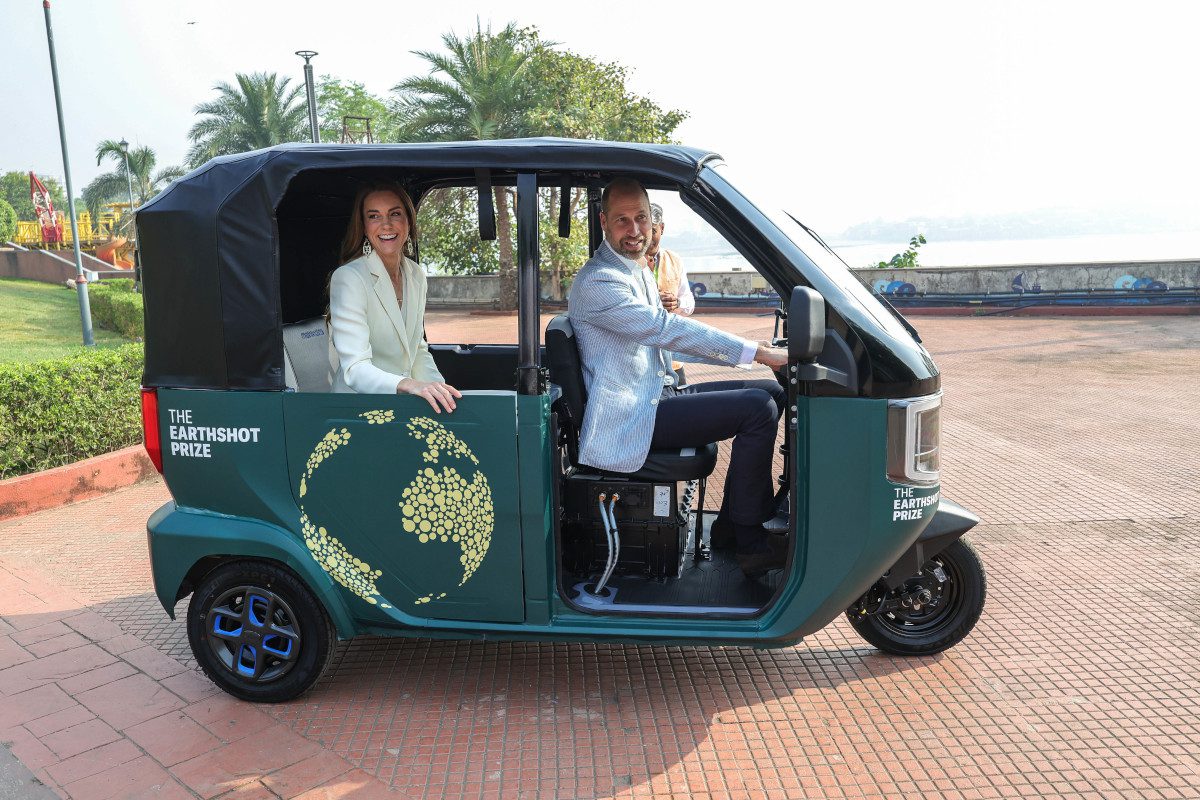
Mahindra Last Mile Mobility makes electric three-wheelers, small vans and rickshaws used for short urban journeys. The organisers say the company has overhauled its supply chain and now sells more electric three-wheelers than any other company in India, showing that the switch can be made “profitably, not just responsibly”. The company says it has sold more than 400,000 electric vehicles, including over 100,000 in a single year, and plans to expand across Asia and Africa, with a target of one million electric vehicles on Indian roads by 2031.
Speaking at the Earthshot Impact Assembly in Mumbai the day before the awards, Prince William singled out Mahindra and fellow Indian finalist Mahila Housing Trust, which works on heat resilience for low-income women. “These are not distant environmental ambitions; they are solutions that improve lives,” he said.
Protect and Restore Nature: Bhutan
Bhutan’s constitution requires at least 60% of the country to remain under forest cover; it currently maintains close to 70%. According to coverage of the awards, these forests protect watersheds on which around 1.6 billion people downstream in South Asia depend. The Government plans to put the prize money towards Restore Bhutan, launched in 2025, which aims to restore 50,000 hectares of degraded forest, farmland and urban land by 2030.
Revive our Oceans: Niue Ocean Wide Trust
The Niue Ocean Wide Trust sells Ocean Conservation Commitments at NZ$250 a year, each covering protection of one square kilometre of ocean for 20 years. About 40,000 have reportedly been sold to more than 800 buyers, including individuals, companies and governments. The prize money will go towards a NZ$32 million endowment intended to fund protection permanently.
The other finalists
The 15 finalists also included AirQo, which uses low-cost monitors and open data to track air pollution in African cities; Argentina’s Satellites on Fire, an AI-based wildfire detection platform; the Zero Emission Maritime Buyers Alliance (ZEMBA); the City of Barcelona, for coastal climate adaptation; South Korea’s Zero Waste Movement Network, which helped build the country’s food waste diversion system; the Philippines’ Mother Earth Foundation; Kenya-based climate insurer Pula; Mahila Housing Trust; Yellowstone to Yukon Conservation Initiative; and Australia’s Indigenous Desert Alliance.
The awards ceremony will be streamed on Prime Video from 30 November.