



Matthew Fall, Technology Analyst with market intelligence firm IDTechEx explains more about the impact of the differing approaches to the PFAS problem, a topic explored more fully in the group’s new report.1
Poly- and perfluoroalkyl substances, also known as PFAS or “forever chemicals” are a family consisting of thousands of fluorinated organic substances, which have been used since the mid-20th century across a vast range of different application areas. PFAS are highly stable, both physically and chemically, and can repel both water and oil. They are, however, highly persistent in the environment and bioaccumulative, and have been found in our drinking water, our food, and our blood. With some PFAS, such as perfluorooctanoic acid (PFOA) and perfluorooctanesulfonic acid (PFOS) associated with numerous health and fertility problems, governments worldwide are establishing legislation to restrict, remove, and destroy PFAS in the environment. On either side of the Atlantic, contrasting approaches are being employed by the EU and the USA to tackle the PFAS problem.
While the EU is in the process of restricting the use of PFAS across industry, forcing players to invest in alternatives, the USA is instead focusing on removal and destruction technology investments, establishing maximum PFAS contaminant levels in drinking water (though the Trump administration’s EPA is in the process of rolling some of these back). IDTechEx expects that annual spending on PFAS treatment technologies for drinking water will grow to US$3.45 billion by 2037, representing a CAGR of 13% over the forecasting period.
EU regulatory pressure fuels demand for PFAS-free alternatives
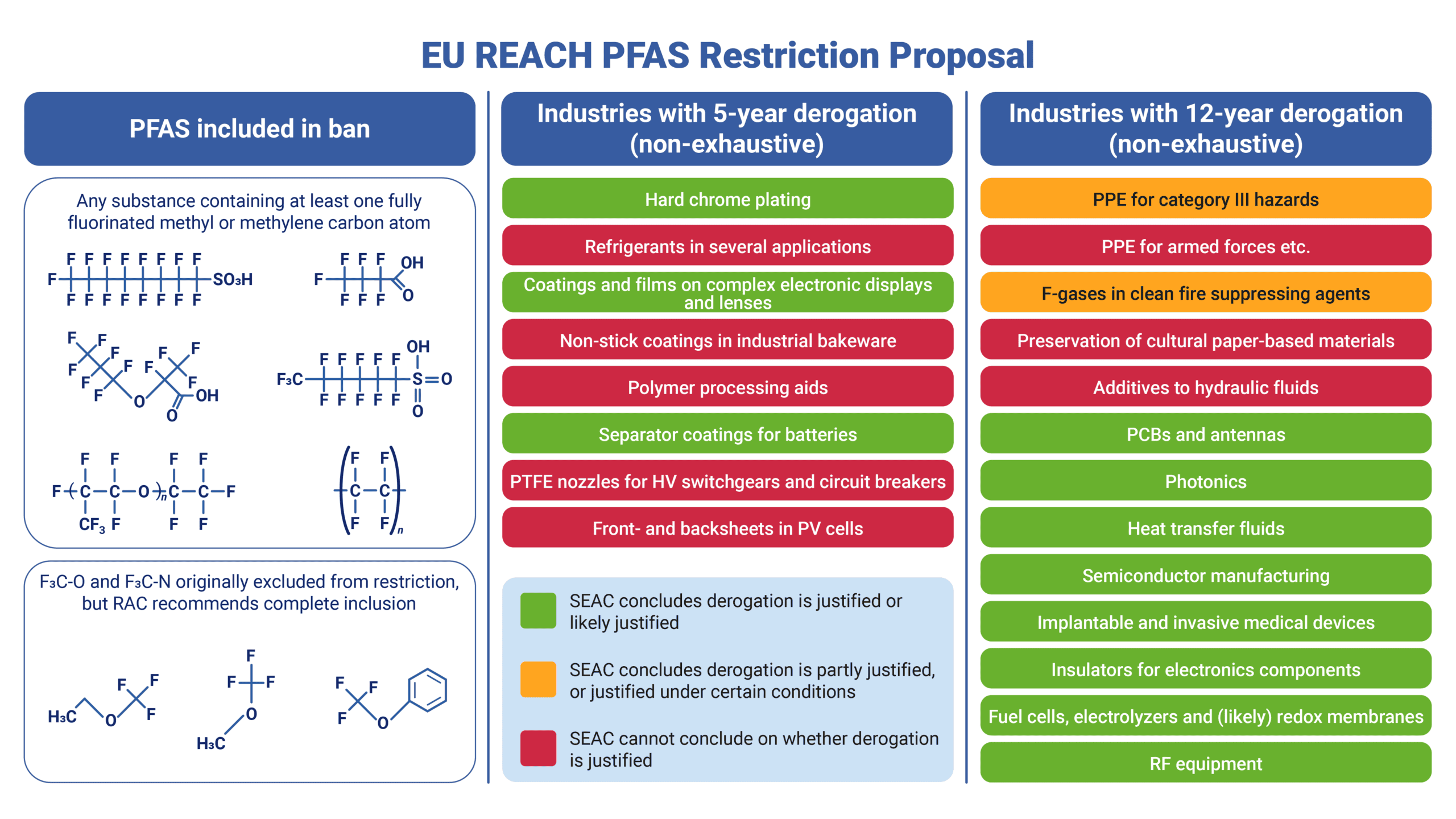
The European Chemicals Agency (ECHA) is in the process of developing legislation that will restrict the use of all PFAS across all applications. This legislation, originally proposed in 2023, has been subject to intense scrutiny from players across a wide range of industries in the EU. Critics of the ban argue that it places unwarranted pressure on industries whose sovereignty the EU must, in their view, support, such as semiconductor manufacture and data center infrastructure.
The ECHA’s Risk Assessment Committee (RAC) and Socio-Economic Assessment Committee (SEAC) acknowledge that derogations must be granted for industries where PFAS-free alternatives are not yet available. However, it seems increasingly unlikely that any PFAS (including polymers) will be exempt, and also unlikely for time-unlimited derogations to be granted, which creates a significant and urgent market opportunity for the development of PFAS-free alternatives across a range of critical industries, including membranes (e.g. in the hydrogen economy), semiconductor and electronics manufacture, batteries, and more. The new report draws upon IDTechEx’s research expertise across these industries to evaluate the outlook for PFAS-free alternatives in these markets.
America’s PFAS strategy creates a market for removal and destruction
The American attitude to PFAS, at least at a federal level, is very different. It is unlikely for the USA to issue sweeping bans on PFAS, such as those that are being proposed in the EU. Instead, focus has been placed on limiting the amount of PFAS present in drinking water. Under the Biden administration, strict limits of either 4.0ppt or 10ppt were placed on six different PFAS molecules, enforceable from 2029 (though the EPA under the Trump administration is pushing to remove some of the molecules from this restriction and extend the enforcement date to 2031). Either way, the focus in the USA is on removing and destroying PFAS used industrially, rather than restricting their use.
A range of incumbent and emerging PFAS treatment technologies are evaluated in IDTechEx’s “PFAS Regulations, Alternatives, Removal, and Destruction 2027-2037: Technologies, Players, Market Outlook”, based on conversations with leading players in the industry. Established filtration technologies such as granular activated carbon (GAC) and ion exchange (IX) resins are effective at removing PFAS but produce large amounts of spent waste which must be either treated or destroyed and are often sensitive to other contaminants.
Emerging technologies such as foam fractionation continue to gain ground and are proving effective at treating a range of water sources, including raw sewage. IDTechEx also evaluates destruction and disposal technologies, comparing incumbent technologies such as incineration and landfilling to emerging destruction methods such as supercritical water oxidation (SCWO) and hydrothermal alkaline treatment (HALT). While spending on PFAS treatment is certainly concentrated in the USA, legislation such as the EU Drinking Water Directive and other contaminant limits worldwide continue to drive increased spending on drinking water treatment.
Depending on location, the attitudes towards PFAS are vastly different. This creates varied opportunities worldwide, whether for PFAS-free alternatives or for PFAS treatment technology.
- For more information on the report, visit www.IDTechEx.com/PFAS.
Notes
[1] “PFAS Regulations, Alternatives, Removal, and Destruction 2027-2037: Technologies, Players, Market Outlook”, IDTechX.