



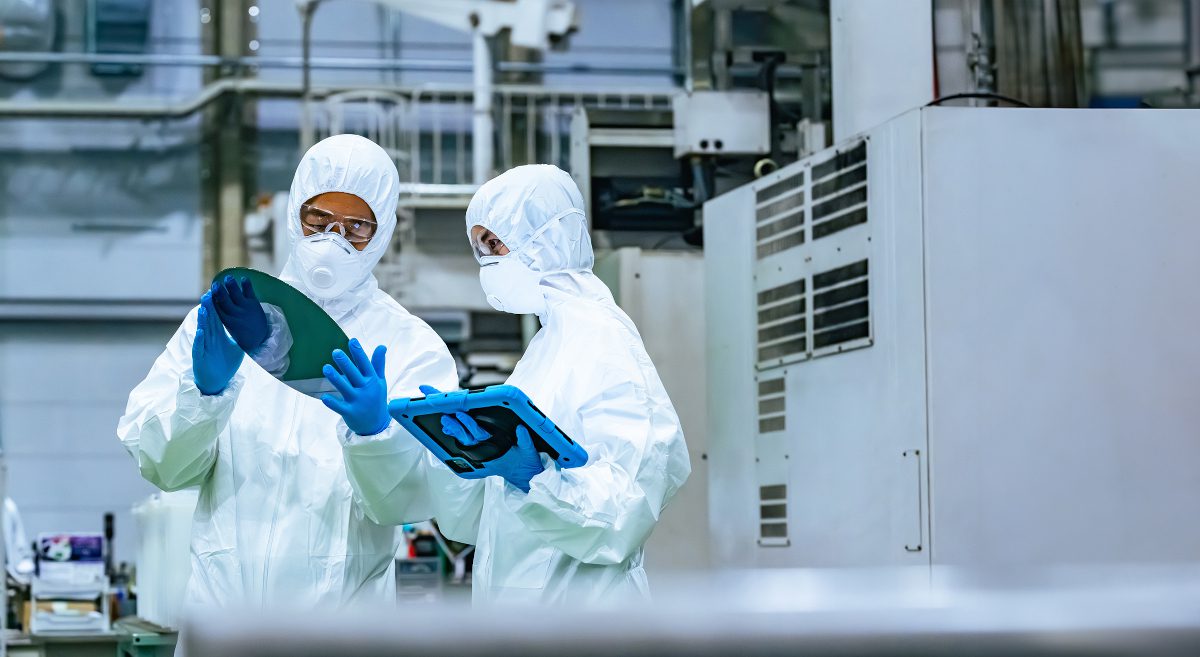
Rapid growth in AI infrastructure could contribute to a substantial expansion in global production of PFAS, according to new research from chemicals campaign group ChemSec, as manufacturers invest in additional capacity to serve semiconductor, data-centre and battery markets.1
The International Chemical Secretariat (ChemSec) says its analysis of the world’s ten largest producers of per- and polyfluoroalkyl substances (PFAS) found that most are expanding production capacity, with demand associated with AI and data centres, semiconductor manufacturing and lithium-ion battery materials among the principal drivers.
PFAS comprise a large and diverse group of highly persistent synthetic chemicals whose resistance to heat, water, oil and chemical degradation has resulted in their use in numerous industrial applications. Those same properties have also contributed to widespread environmental contamination and created significant difficulties for water and wastewater treatment.
ChemSec’s analysis, published on 13 September, points to planned or ongoing investments by fluorochemical manufacturers in Europe, North America and Asia.1
Among the examples cited is Japanese manufacturer Daikin, which ChemSec says plans to more than triple fluoropolymer production capacity in response to growth in the semiconductor market, including through a new production facility due to begin manufacturing next year.
The organisation also highlights expansion associated with fluoropolymers for lithium-ion batteries, while identifying growing AI-related demand as an important commercial opportunity for parts of the fluorochemicals sector.
ChemSec characterises the trend as a potential “tidal wave” of new PFAS output and argues that it could undermine attempts to restrict the substances.2 Its conclusions form part of the organisation’s campaign for broad restrictions on PFAS, with strictly time-limited exemptions for uses where alternatives are not yet available.
Semiconductors present treatment challenge
The warning coincides with the publication of new research examining what happens to PFAS within a full-scale semiconductor wastewater treatment plant.
A study published online in the Journal of Hazardous Materials on 11 September examined 24 PFAS across seven segregated wastewater treatment systems and four treatment processes at a large semiconductor manufacturing facility.3
The researchers note that PFAS are used in a range of semiconductor manufacturing processes because of their distinctive chemical properties. They say the rapid expansion of semiconductor production associated with technologies such as AI is increasing the importance of controlling the resulting emissions.
Of the 24 target substances, 20 were detected in samples from the facility, with an average detection frequency of 82.6%. Short-chain PFAS and newer alternatives dominated the wastewater profile, while approximately 47% of the PFAS load was associated with particles larger than 0.45 micrometres.4
Treatment performance varied considerably.
Reported removal efficiencies ranged from -472% to 69%. Negative removal does not mean that a treatment plant literally creates PFAS from nothing; rather, the researchers say the apparent increases indicate that previously unmeasured precursor compounds may be transformed during treatment into PFAS included in the analysis.
The study’s mass balance supported this interpretation. It calculated an influent load of 1.49kg/year for the PFAS being measured, compared with combined outputs comprising 1.58kg/year retained within the treatment system and 0.67kg/year discharged in effluent.5
The authors conclude that conventional semiconductor wastewater treatment has significant limitations in intercepting short-chain and emerging PFAS.
Chemical precipitation helped transfer some longer-chain compounds into sludge but could also result in the secondary release of shorter-chain PFAS, while adsorption units experienced rapid breakthrough under the conditions examined. Terminal ion-exchange resins therefore played an important role in the treatment train.6
PFOS in the final effluent retained an ecological risk quotient greater than one, while the researchers say the discharge of short-chain alternatives warrants greater monitoring attention.
Growing environmental liability
The findings illustrate a potentially significant environmental consequence of expanding semiconductor production.
Semiconductor manufacturing uses PFAS because the substances can perform under highly demanding chemical and thermal conditions, making substitution technically difficult in some applications. A review published earlier this year in Environmental Science & Technology similarly identified PFAS waste management as a growing challenge for the semiconductor industry as production expands while environmental regulation tightens.7
The issue extends beyond chip fabrication itself. ChemSec also points to the use of fluorinated substances in cooling technologies for increasingly powerful data centres, identifying this as another potential source of growing demand for PFAS.8
ChemSec says that growing demand from these applications is helping create commercial incentives for additional fluorochemical production at the same time as regulators are attempting to tackle the legacy of decades of PFAS releases.
That legacy is already producing substantial remediation and legal costs. On 10 September, Chemours, DuPont and Corteva agreed a $455 million settlement with the US state of North Carolina and 11 local public bodies over claims relating to PFAS contamination associated with Chemours’ Fayetteville Works facility and historical discharges.9
The settlement follows other multibillion-dollar agreements in the US concerning PFAS contamination and drinking water.
Notes
[1] International Chemical Secretariat (ChemSec), The world’s top 10 PFAS producers — most are expanding production, 13 September 2026.
[2] Alfie Patterson, “PFAS producers ramping up production – report”, Ecotextile News, 14 September 2026.
[3] Ao Xian et al., “Unveiling the fate and transformation of per- and polyfluoroalkyl substances (PFAS) in full-scale semiconductor wastewater treatment”, Journal of Hazardous Materials, available online 11 September 2026, article 143576, DOI: 10.1016/j.jhazmat.2026.143576.
[4] Ibid.
[5] Ibid.
[6] Ibid.
[7] “Challenges and Opportunities in PFAS Waste Management for Semiconductor Manufacturing”, Environmental Science & Technology, Vol. 60, No. 3, 2026, pp. 2259–2276, DOI: 10.1021/acs.est.5c10109.
[8] Tom Perkins, “‘Tidal wave’ of Pfas being launched to satisfy AI industry, campaigners warn”, The Guardian, 14 September 2026.
[9] Reuters, “Chemours, DuPont, Corteva settle North Carolina ‘forever chemicals’ claims for $455 million”, 10 September 2026.