



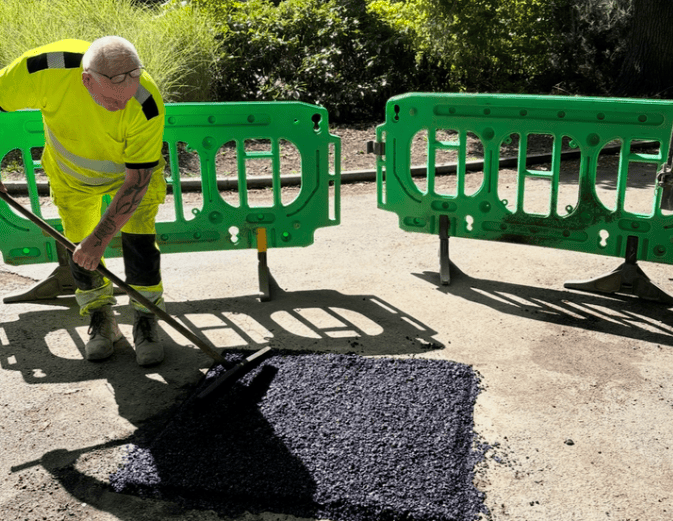
Old clothes are being used to fix potholes in Maidstone’s parks in a trial involving Maidstone Borough Council and sustainable materials company RECOOL.
The council is testing a pothole repair material made from recycled textile waste at Mote Park and Penenden Heath. The pilot is taking place on council-owned land and does not involve public roads, which are maintained by Kent County Council.
As the authority responsible for maintaining parks, open spaces and car parks across the borough, Maidstone Borough Council hopes the trial will demonstrate whether the material can provide a durable, lower-impact alternative to conventional repair materials.
Five potholes – two at Mote Park and three at Penenden Heath – have been repaired using an experimental product described by RECOOL as a lower-carbon alternative to conventional materials and installed in partnership with contractor Loughman. The material uses recycled textile waste to fill most of the pothole, with a specialist surfacing layer applied on top.
According to circular economy organisation WRAP, the UK generates around 1.45 million tonnes of used textiles each year, with almost half ending up in general waste rather than being reused or recycled. The project aims to explore whether some of this material could instead be incorporated into infrastructure repair products.
Councillor Rachel Rodwell, Cabinet Member for Climate Transition and Nature Recovery, said: “While second-hand selling sites have helped extend the life of many clothes, fast fashion means huge amounts of textiles are still being thrown away every year.
“This pilot is about turning that problem into an opportunity. By testing whether waste textiles can be repurposed as part of a pothole repair material, we’re exploring a practical solution that could reduce waste, cut carbon emissions and support the circular economy.
Councillor Clive English, Deputy Leader and Cabinet Member for Environmental Services and Enforcement, said the trial would allow the council to assess the material “in real-world conditions” and added that Maidstone was keen to share its findings with other authorities.
The repairs have been completed recently and will be monitored over the coming months to assess their performance under normal park use and weather conditions. Any future use of the product will depend on the outcome of the trial.
Elise Daly of RECOOL said the company transforms mixed textile waste into “practical, lower-carbon alternatives to traditional plastic products”, creating uses for material that might otherwise go to waste.