



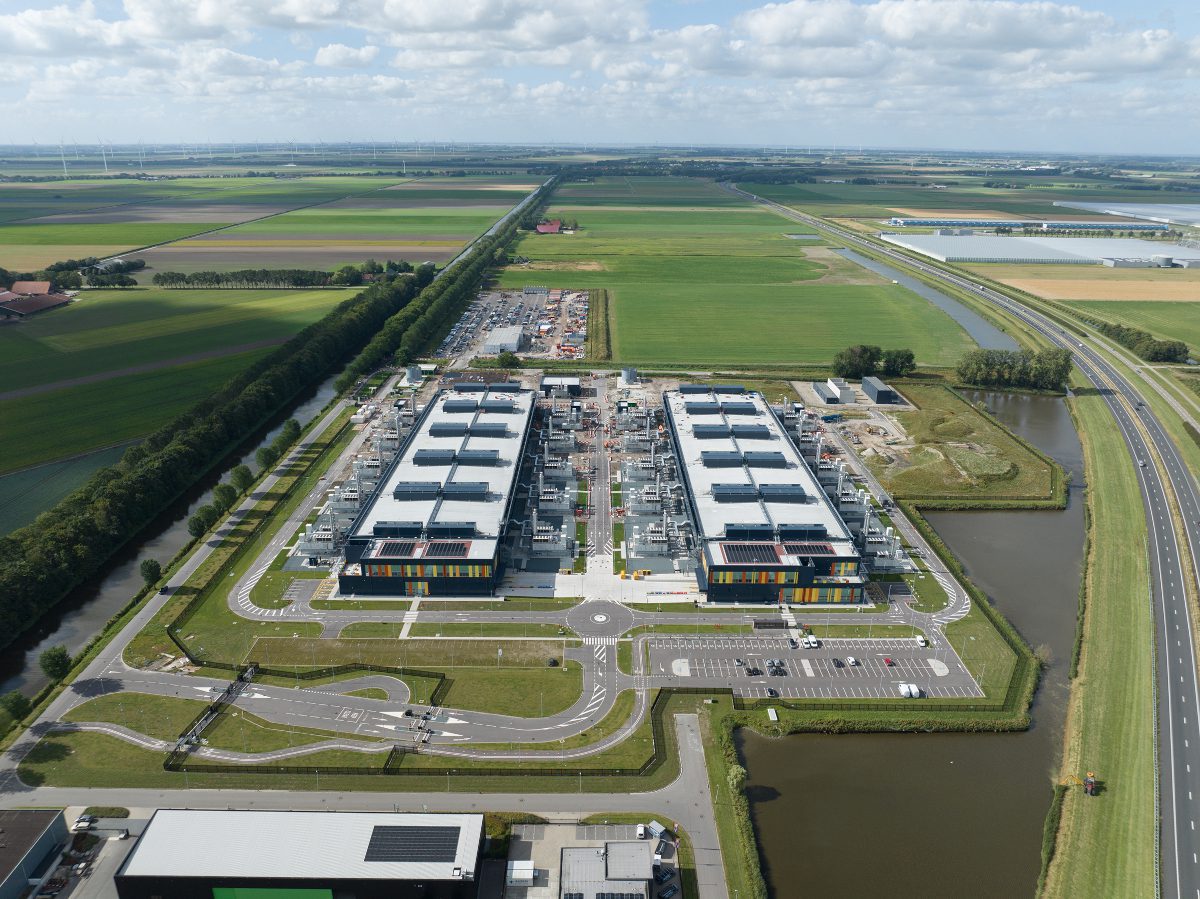
Campaigners are calling for stricter controls on the environmental impacts of hyperscale data centres in Scotland, as plans for a £16.5 billion development at Chapelcross raise questions about electricity demand, water consumption and the adequacy of existing planning safeguards.
The Foundation for Gaia, a human rights and environmental charity, has written to the Scottish Government urging it to introduce binding resource-use limits, mandatory environmental reporting and a national strategy for data centre development. The intervention follows the submission of plans by CX Tech for a 1GW data centre campus near the former Chapelcross nuclear power station in Dumfries and Galloway.
The proposed campus would comprise eight data centre buildings providing approximately 162,000m² of floorspace, alongside a substation, training centre and associated infrastructure. If approved, it would rank among the largest developments of its kind in the UK, although other projects of comparable or greater capacity have also been proposed.
The scale of the development illustrates the challenge facing Scottish planners as demand for computing infrastructure accelerates, particularly with the growth of AI.
In its open letter to Public Finance Minister Hannah Mary Goodlad, dated 1 October, the Foundation for Gaia argues that individual planning decisions cannot adequately address the cumulative environmental impacts of multiple large developments. It estimates that 24 major data centre proposals were in or approaching Scotland’s planning system at the beginning of September, representing approximately 6GW of potential power demand.
The organisation recommends that the Scottish Government establish how much data centre capacity the country needs and can sustainably accommodate before granting further consents. It also wants developments sharing electricity grid connections, water catchments or local authority areas to be assessed collectively.
Scrutiny of resource demands
The Scottish Government has already moved to strengthen environmental oversight. A direction taking effect on 17 September requires environmental impact assessments (EIAs) for new data centre developments exceeding 50MW of power capacity. Smaller proposals remain subject to case-by-case assessment.
In announcing the measure, the government acknowledged potential impacts on biodiversity, soils, water resources, noise and air quality, including emissions from backup generators. It also identified opportunities to reduce environmental impacts through renewable electricity and closed-loop cooling systems.
However, the Foundation argues that the new requirements must be accompanied by standardised reporting and enforceable operating conditions.
Its recommendations include prohibiting the use of drinking-quality water for data centre cooling, setting limits on water consumption and requiring operators to publish independently verified annual figures for electricity use, water consumption and emissions.
The charity also proposes mandatory consideration of waste heat recovery, including opportunities to supply district heating networks, alongside comprehensive assessment of backup generators and associated fuel storage.
A further recommendation is the creation of a public register of data centres, together with a clearer definition of what constitutes a ‘green data centre’ under Scottish planning policy.
The Scottish Government has indicated that it does not anticipate planning applications being determined before new national guidance is issued later this year. However, this is not a formal prohibition on submitting applications.
Finnish intervention
The Foundation’s warning comes as Finnish regulators have instructed Google’s subsidiary Tuike Finland to suspend environmentally significant preparatory work at two proposed data centre sites in Muhos and Kajaani.
The Finnish Licensing and Supervision Authority issued the instruction on 6 October after extensive site preparation, including tree clearance, topsoil removal and road construction, took place before environmental impact assessments were completed. The company has been told to stop the relevant activities immediately, and no later than 23 October.
Google has acknowledged shortcomings in its approach and said it intends to comply with the regulator’s instructions, while maintaining that it had undertaken environmental surveys and protective measures.
For the Foundation for Gaia, the Finnish case illustrates the importance of completing environmental scrutiny before irreversible work begins.
The charity is calling for environmental requirements to be incorporated into enforceable planning conditions, supported by ongoing monitoring and meaningful community involvement.
The underlying question is whether Scotland can accommodate the proposed expansion of digital infrastructure while ensuring that its cumulative demands on energy, water and the environment remain within sustainable limits.
Notes
[1] Foundation for Gaia, Open letter to the Scottish Government on national planning guidance for data centres, 1 October 2026.
[2] Data Centre Review, CX Tech submits plans for 1GW Chapelcross data centre campus, 1 October 2026.
[3] Foundation for Gaia, Open letter to the Scottish Government on national planning guidance for data centres, 1 October 2026 (see [1]).
[4] Scottish Government, Data centres: Chief Planner letter and EIA Direction – September 2026, 16 September 2026.
[5] Scottish Parliament, Official Report, Meeting of the Parliament, 17 September 2026.
[6] Finnish Licensing and Supervision Authority (LVV), Notice concerning suspension of preparatory work at the Muhos and Kajaani data centre projects, 6 October 2026 (in Finnish). See also Yle News, 8 October 2026 for English-language reporting.