

An EU-funded project developing a fuel-flexible gas turbine system for ships has reported progress in hydrogen combustion, heat recovery and magnetic bearing technologies, as it reaches the halfway point of its four-year programme.
The MARPOWER project, coordinated by Finland’s LUT University, aims to develop an energy conversion system capable of operating on a range of alternative fuels, including hydrogen, ammonia, renewable methanol and renewable methane. The proposed system would provide onboard power generation and cogeneration, with improved thermal efficiency intended to reduce fuel consumption.
Two years into the project, researchers have completed the overall system design and developed detailed designs for its principal components. Several technologies have entered manufacturing and experimental testing, although integration and validation of the complete system remain to be undertaken.
Among the most significant advances is the successful testing of a combustion chamber prototype operating on 100% hydrogen. The prototype was manufactured and instrumented before undergoing testing in an atmospheric test rig, following computational fluid dynamics (CFD) simulations and the installation of hydrogen supply infrastructure.
The results are informing the development of a second combustion chamber prototype, incorporating a more flexible air distribution system and further geometry optimisations. These modifications are intended to improve the system’s ability to accommodate different fuels with limited changes to the combustion equipment.
Improving efficiency through heat recovery
The project is also investigating ways to recover and reuse thermal energy within the gas turbine cycle and from its exhaust gases.
The group has manufactured and assembled a scaled prototype recuperator, designed to transfer heat within the turbine cycle. The unit, built at 1:100 of the proposed system’s capacity, has passed non-destructive testing and pressure testing at 22.3 bar.
The recuperator incorporates a new heat-transfer surface geometry and has been manufactured using automated robotic laser welding. Further experimental validation is planned.
Alongside this, the design of a complementary waste heat recovery system has been completed, covering the boiler, steam turbine, pump, generator and associated equipment. The combined approach is intended to improve overall energy efficiency and reduce fuel requirements.
The project also reports progress in the design of the system’s compressors and turbines. A new optimisation procedure for the high-pressure turbine’s internal cooling channels has produced a design requiring approximately 15% less coolant flow than estimates derived from standard literature correlations, according to simulations.
Magnetic bearings and digital modelling
MARPOWER’s high-speed rotating machinery requires bearing and control
technologies that can support the rotor while limiting mechanical wear.
Active magnetic bearings (AMBs) support the rotor without conventional
mechanical contact and allow its position to be actively controlled. As the group explains, this is an important part of the MARPOWER energy conversion system.
A new axial magnetic bearing has been manufactured and installed in an existing flywheel test rig, where initial impact and recovery tests have been completed successfully.
Researchers are also developing a scaled rotor and hydraulically actuated platform to investigate the behaviour of the proposed 2.7 MW rotor system under simulated ship movements, including surge, pitch and roll.
In parallel, a digital twin of the MARPOWER system is being developed to simulate the interaction of its components under different operating conditions.
An initial calibrated model has been established, with automated simulations covering part-load operation, variations from design conditions and fuel switching. Early sensitivity analysis has identified turbine inlet temperature, ambient temperature and compressor efficiency as important influences on power output and thermal efficiency.
The model will be progressively refined using experimental results as component testing continues.
Next steps towards shipboard integration
During the project’s remaining two years, attention will shift towards integrating the individual technologies and evaluating their performance under more representative operating conditions.
Two vessel case studies, involving a container ship and a cruise ship, will investigate engine-room arrangements and use digital simulations to assess energy consumption and emissions under different operating scenarios. The studies will also consider the potential for incorporating MARPOWER technologies into existing vessels.
Further work will address safety, regulatory compliance, lifecycle environmental impacts and costs.
Professor Jussi Sopanen, MARPOWER Project Coordinator at LUT University, said: “During the first half of MARPOWER, we have advanced the system design, developed key technologies and started generating experimental results. The challenge now is to bring these developments progressively together, extend testing under more representative conditions and generate the evidence needed to assess the complete system and its integration on board ships”.
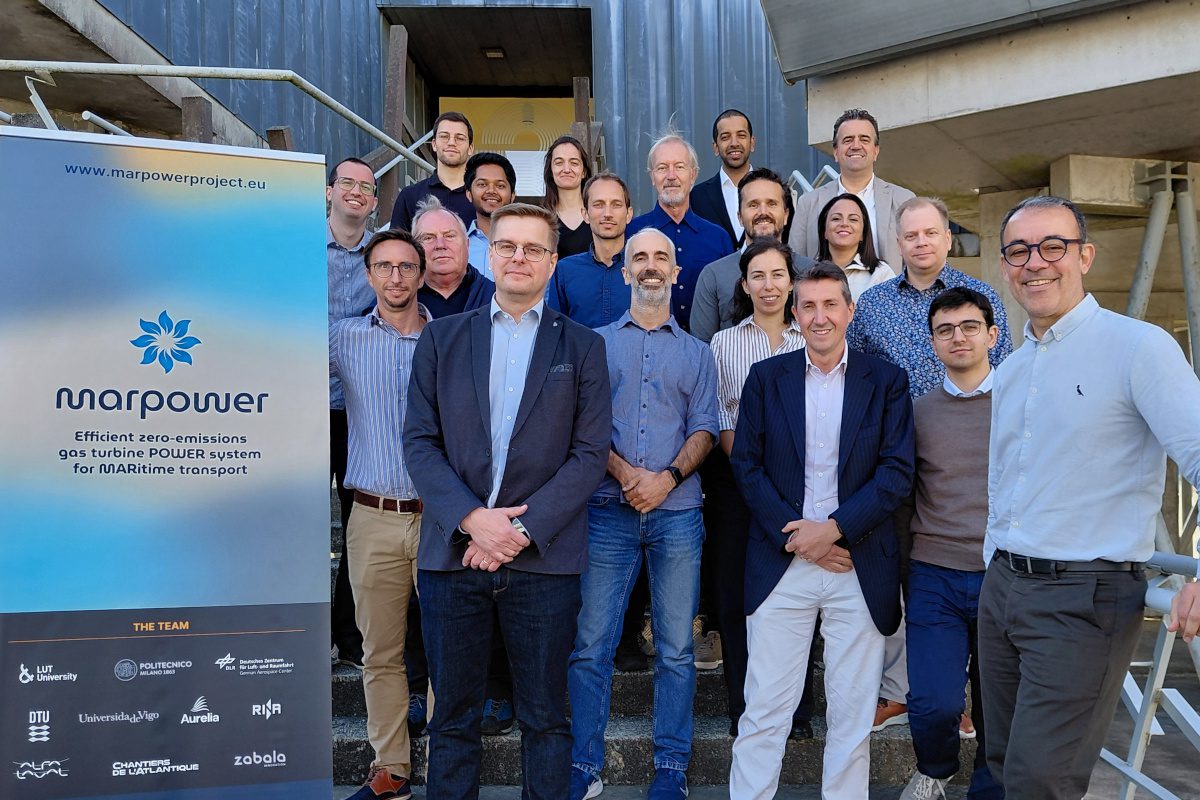
The project involves 11 partners from six European countries, including Alfa Laval, the German Aerospace Center (DLR), the Technical University of Denmark and Chantiers de l’Atlantique. It is scheduled to continue until August 2028.
Further information: marpowerproject.eu