
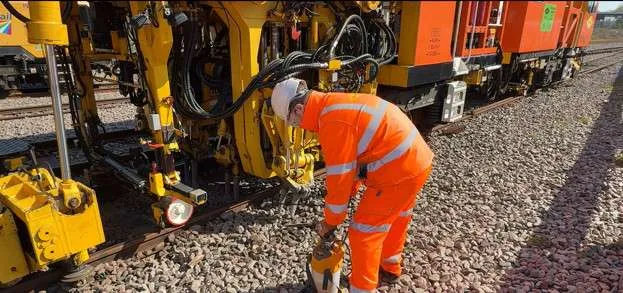
 This article contains paid for content produced in collaboration with A&S International.
Rail depots and trackside sites face spill risks that absorbents alone may not deal with, according to A&S International, which supplies the bioremediation product Oil Spill Eater II. The group makes the case that response plans should name specific approved treatment products.
Environmental guidance for railway operations sets out clear expectations for fuel spill contingency planning at depots, reflecting the statutory obligations that apply to sites handling controlled substances. According to A&S International, under the Environmental Permitting (England and Wales) Regulations 2016, site operators handling controlled substances must maintain adequate contingency plans. Getting this wrong is not a minor administrative issue, the company says. Failure to maintain or execute an adequate plan can result in enforcement notices, unlimited fines and prosecution under the Environmental Protection Act 1990.
Where the risk actually comes from
Rail depots face multiple release pathways that many other industrial sites do not. Regular refuelling operations, hydraulic fluid from maintenance vehicles and close proximity to drainage infrastructure all create opportunities for contamination. Trackside incidents bring their own complications too, often occurring in locations where access for conventional clean-up equipment is severely limited.
The combination of these factors means that a single rail depot can face a wider range of plausible spill scenarios than a comparable facility in another industry, simply because of how many different activities and access constraints exist on a typical site. A spill response plan that only accounts for the most obvious scenario, a fuel pump leak in an open yard, leaves real gaps. Trackside ballast, in particular, behaves very differently to a hard standing surface once contaminated, since the spill can move downward and outward through the stone bed in ways that are not always visible from the surface.
Why conventional clean-up falls short
Absorbent pads and granular materials work reasonably well on a clean, accessible surface, but they cannot address diesel that has penetrated ballast, migrated into drainage channels or reached lineside soil. This is where, according to A&S, bioremediation earns its place in a spill response plan.
The company says its product Oil Spill Eater II (OSE II), applied via handheld sprayers or backpack units, treats the spill in situ regardless of terrain, converting hydrocarbons to CO2 and water without the need for excavation. A&S argues that for depot teams used to relying on absorbents alone, building an oil spill clean-up capability into the plan, rather than just a containment response, changes what can be achieved once an incident has happened.
Regulatory credentials
A&S says OSE II is the only bioremediation product on the UK Marine Management Organisation’s (MMO) Approved Oil Spill Treatment Products schedule, and that it is also approved by the US EPA National Contingency Plan. According to the company, a live demonstration carried out by Colas Rail UK during Earth Day in April 2026 provided direct evidence of its operational suitability in a genuine rail environment, rather than a controlled laboratory setting.
The company argues that this matters because spill response plans should cite approved products by name and regulatory reference, not by generic category. In its view, OSE II’s MMO listing and EPA registration provide the kind of specific credentials that make a plan defensible during an enforcement inspection, where vague references to general clean-up materials are unlikely to satisfy a regulator.
A&S says peer-reviewed research has confirmed OSE II’s status as the only bioremediation product on the MMO’s approved schedule, and that the US EPA’s own product bulletin confirms its National Contingency Plan listing and authorisation.
Putting it into practice at depot level
A formal spill response plan is only as good as the products and procedures behind it. Concentration ratios, application methods and documentation all need to be specified clearly enough that anyone on site can act correctly under pressure, not just the person who wrote the plan.
A&S International says it supplies OSE II in depot stockpiling volumes, alongside technical guidance covering these details, so that the plan reflects what can actually be done on the day, by whoever happens to be on shift when an incident occurs.
Why this is worth reviewing now
Spill response plans are easy to write once and then forget about, but regulations and best practice both move on. A&S suggests that if a current plan references generic clean-up materials rather than specific approved products, it may not hold up under the kind of scrutiny that follows a genuine incident. In the company’s view, a depot that treats oil contamination control as an ongoing capability, rather than a box-ticking exercise revisited only after an incident, is in a stronger position both operationally and in front of a regulator. The group adds that this also feeds into wider industrial sustainability reporting, since a documented, in-situ response avoids the additional environmental cost of excavation and waste transport that conventional clean-up methods carry.
A&S International can discuss depot-specific requirements and bulk supply options.