



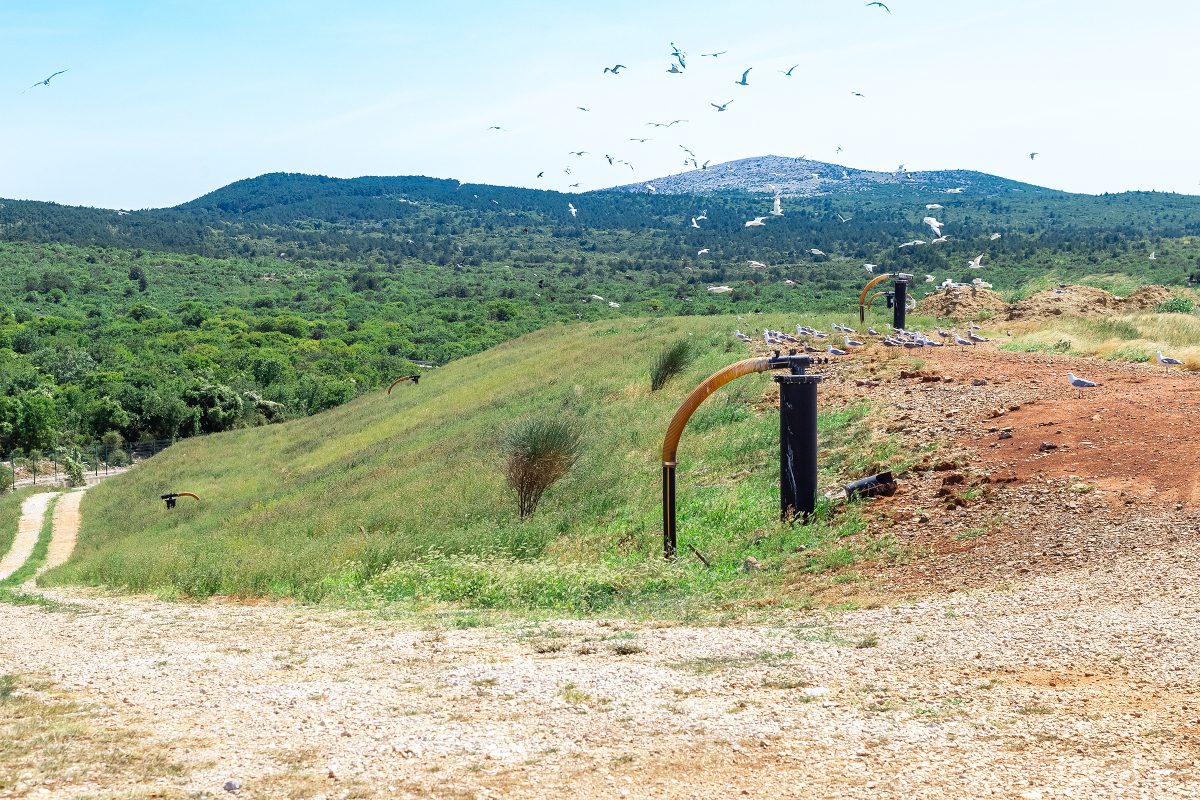
A system that uses weather data to estimate communities’ exposure to landfill gases could provide an early-warning mechanism for pollution episodes, according to research from the University of Leicester and UK Health Security Agency (UKHSA).
The researchers developed a machine-learning framework called CAIRN (Causal-Anchored Inference for Receptor Nowcasting), designed to identify conditions associated with elevated hydrogen sulphide (H₂S) around landfill sites as an emission episode unfolds.
Unlike systems based on direct gas monitoring, the system can operate using routinely collected meteorological measurements and calendar information. Its predictions were found to track both readings from a network of gas sensors and an independent record of odour complaints from the surrounding community.
The researchers argue that this could help shift responses to fugitive emissions away from investigating incidents after communities have already been exposed and towards intervention while an event is occurring.
H₂S is produced under anaerobic conditions in decomposing waste and is recognisable from its characteristic rotten-egg smell. The odour can be detected at concentrations substantially below those associated with toxic effects, but persistent malodour can itself affect wellbeing through irritation, headaches, sleep disturbance and psychological stress.
The research used monitoring data from a European landfill associated with persistent odour problems and community concern. The authors are Timothy Pearce of the University of Leicester’s Biomedical Engineering Research Group, and David Smith, Alec Dobney and Alessia Freddo of UKHSA’s Environmental Hazards and Emergency Department.
Weather signals
A year of 2024 data from the principal monitoring location provided more than 34,000 valid 15-minute records covering H₂S, methane and meteorological conditions.
Analysis identified wind direction, wind speed and atmospheric pressure as important drivers of receptor exposure, operating over different timescales. Wind direction determines whether a particular receptor is downwind of a source, while wind speed influences the dilution of emissions. Changes in atmospheric pressure can also affect the movement of gas from the waste mass.
The researchers also found a pronounced daily pattern. Mean H₂S concentrations peaked at 2am and reached their lowest point between noon and 3pm. When measurements were aligned with sunrise, the average concentration fell from 9.49µg/m³ before sunrise to 1.30µg/m³ within four hours.
This was consistent with the role of the atmospheric boundary layer. Stable conditions during the night can trap emissions close to the surface, whereas increasing convective mixing after sunrise disperses accumulated pollutants through a larger volume of air.
CAIRN was designed to reflect these different timescales. It incorporates a fast component corresponding to hour-scale wind-driven transport and a slower component capturing multi-hour changes in weather. Importantly, the model receives only four raw meteorological variables and basic calendar information, rather than requiring analysts to supply manually engineered features such as stagnation or recirculation indices.
The same framework was successfully transferred without modification to a second monitoring location and to methane, which was emitted alongside H₂S.
From sensors to alerts
The researchers combined four individual nowcasters to produce a site-level alert system with four tiers. These were designed around World Health Organization guidance for H₂S odour annoyance.
During a January-to-March 2025 validation period covering 8,536 15-minute observations, the weather-based system assigned the same alert tier as the direct sensor-derived assessment in 79.4% of cases. It performed particularly strongly at recognising normal background conditions, although performance was weaker for less common elevated-exposure categories. For the highest alert tier, around half of the episodes were correctly identified from meteorological information alone.
Community exposure
The researchers then compared the alerts with an entirely independent dataset: daily odour complaints from the surrounding community. This comprised 89 days of records and had not been used to train or configure the model.
The relationship was substantial. Daily average CAIRN alert levels and complaint numbers produced a Pearson correlation of 0.729, compared with 0.793 when alerts were generated directly from gas-sensor measurements. The authors calculate that the weather-based system captured around 84% of the variation in complaints explained by the sensor-derived assessment.
Significantly, the strongest relationship occurred on the same day rather than before or after complaints, supporting the researchers’ description of the system as a “nowcaster” rather than a forecaster. In other words, it is intended to identify community exposure while an event is developing rather than predict an episode days in advance.
Such an approach could potentially provide regulators and public-health authorities with graded triggers for interventions during emission events, rather than relying principally on retrospective investigation of complaints.
The researchers suggest the principle could have wider application to regulated sources of fugitive odorous gases, which include sewage treatment works, composting facilities, intensive livestock operations and biogas plants as well as landfills. Notably, the model was developed using data from a single landfill, which suggests that its performance would need to be established across other sites and types of emission source before it could meet the requirements of wider deployment.
The study, “Meteorology-driven Causal Nowcasting of Fugitive Landfill Emissions Enables Proactive Public Health Response”, was submitted to the arXiv preprint repository in August and had not yet undergone peer review at the time of writing.