



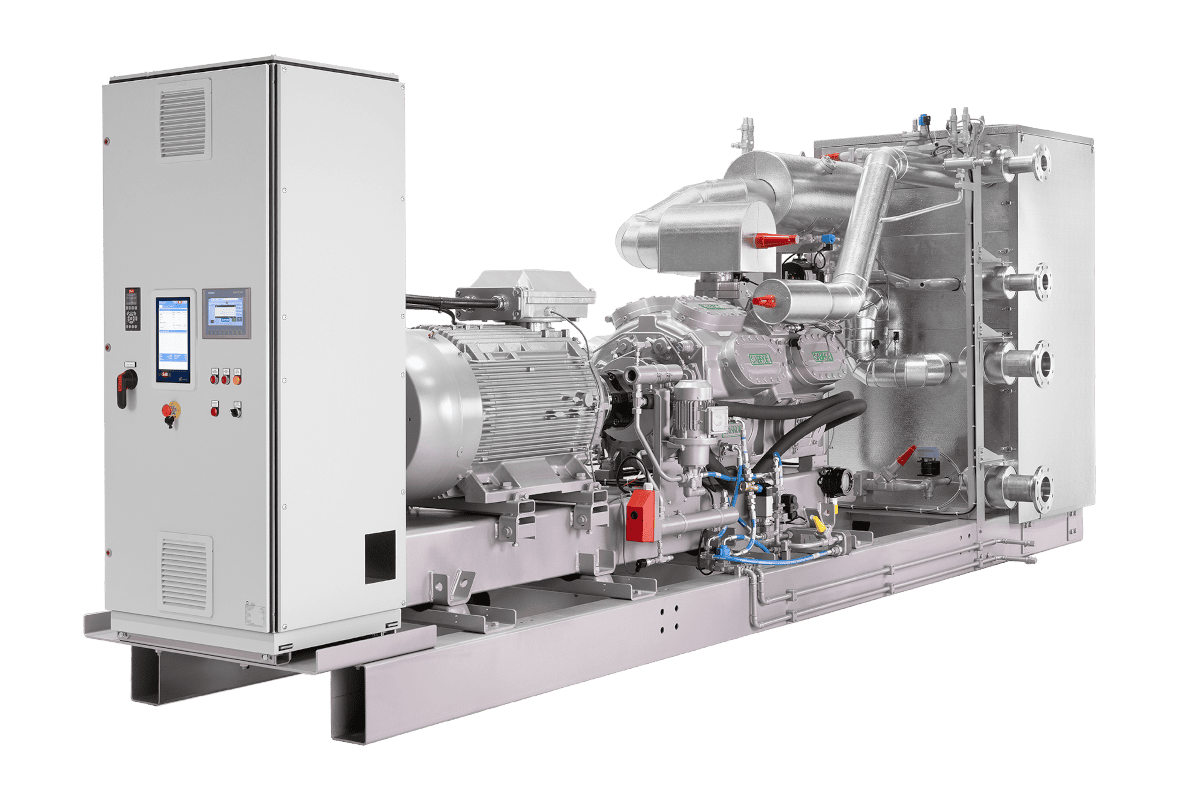
A new range of industrial heat pumps capable of delivering hot water at temperatures up to 122°C has been launched by Johnson Controls, targeting the electrification of process heat in sectors including food and beverage, pharmaceuticals and manufacturing.
The Sabroe HitemHP range has heating capacities from around 100 kW to 1 MW and is designed for applications requiring temperatures that have traditionally been supplied by fossil-fuel or electric boilers.
Potential uses include pasteurisation, sterilisation and other high-temperature processes, as well as indirect steam production. The systems can also recover waste heat from processes such as industrial refrigeration and upgrade it to temperatures suitable for reuse elsewhere at a facility.
The heat pumps use butane or isobutane as refrigerants, both of which have very low global warming potential (GWP). Johnson Controls says the use of natural refrigerants is intended to help industrial users avoid reliance on fluorinated refrigerants affected by tightening EU regulation.
At the heart of the system is a single-stage Sabroe SMC reciprocating compressor. Capacity can be reduced to as little as 18% of the design heating load, allowing output to respond to variations in heat demand.
The group says the heat pump’s coefficient of performance (COP) can be up to 20% higher under part-load conditions than when operating at full capacity, while the compressor design can extend service intervals by nearly 50%.
“Until now, electrifying high-temperature heat has been one of the hardest problems to solve,” said Steve Bell, vice president and general manager, Industrial Refrigeration at Johnson Controls.
“With our new Sabroe high-temperature heat pumps, Johnson Controls is delivering a breakthrough solution that can help critical industries and institutions secure their energy future, significantly cut operational costs and align with the ambitions of Europe’s Clean Industrial Deal.”
The company also reports substantial energy and carbon savings from one application in which a HitemHP system was paired with waste heat from a refrigeration plant. Based on the particular site’s operating conditions and assumptions, Johnson Controls says the system had the potential to reduce on-site CO2 emissions by up to 82%, energy costs by more than 91% and annual water costs by up to 30%.
It also delivered up to three times the energy efficiency of electric boilers in that application. The figures are site-specific, however, rather than general performance claims for the HitemHP range.
The heat pumps are engineered and manufactured at Johnson Controls’ facility in Holme, Denmark, and use a modular, factory-assembled design intended to reduce installation and commissioning requirements.