


Major tyre manufacturers have reported substantial reductions in carbon emissions and water withdrawals since 2021, although falling production, changes in water-stress classifications and rising waste intensity complicate the picture.
Ten of the world’s largest tyre manufacturers reduced their combined greenhouse gas emissions by approximately 36% between 2021 and 2025, according to a new sustainability report from the Tire Industry Project (TIP), an industry initiative operating under the World Business Council for Sustainable Development (WBCSD).
The report, Sustainability Driven: Key Performance Indicators for TIP Members 2021–2025, tracks performance against 16 environmental, social and governance indicators. TIP’s members collectively account for more than 60% of global tyre manufacturing capacity.
Total reported emissions fell from 12.6 million tonnes of CO₂ equivalent in 2021 to 8.1 million tonnes in 2025. Emissions intensity, measured per tonne of finished product, declined by 29.2%, from 0.72 to 0.51 tonnes CO₂e.
However, production volumes also decreased by 9.2% over the five-year period, contributing to the reduction in absolute emissions.
Energy consumption fell by 10.7%, from 171.7 million to 153.4 million gigajoules, while energy intensity improved more modestly, from 9.8 to 9.6 gigajoules per tonne of output.
The proportion of purchased electricity obtained from renewable sources rose from 25.7% in 2021 to 60.5% in 2025. Nine of the ten participating manufacturers now have validated science-based emissions reduction targets, compared with three in 2021.
Water efficiency progress
Water withdrawals across participating manufacturers fell by 18.4% over the reporting period, reaching 87.2 million cubic metres in 2025. Water intensity declined by 9.8%, to 5.5 cubic metres per tonne of output.
The report also records a 35.2% reduction in withdrawals from water-stressed areas, from 21 million cubic metres in 2021 to 13.6 million cubic metres in 2025.
However, TIP acknowledges that this reduction was partly influenced by the reclassification of three manufacturing sites, two in China and one in Vietnam, from high or extremely high water stress to medium or low. The figures therefore do not solely reflect reductions in water use at facilities operating under comparable water-stress conditions.
Waste performance was less encouraging. Although total waste generation remained broadly unchanged at 1.11 million tonnes, waste intensity increased by 9.1% compared with 2021, reaching 69.7kg per tonne of production.
TIP suggests that some manufacturing waste arises independently of production volumes, meaning that falling output can increase the amount generated per tonne of finished product.
Tyre particle pollution remains a challenge
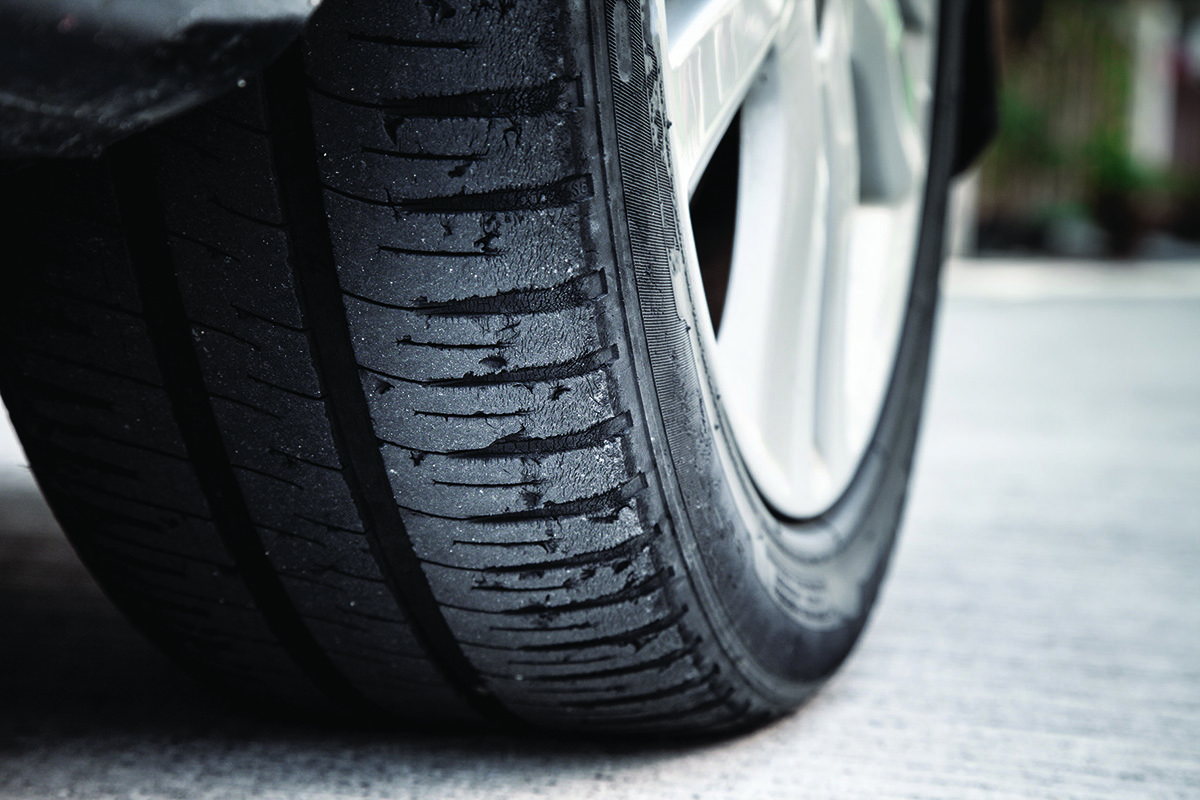
Beyond manufacturing operations, the report documents growing investment in research into tyre and road wear particles (TRWP), generated through friction between tyres and road surfaces.
TIP supported eight new peer-reviewed publications on the subject in 2025, bringing the cumulative total to 36, and committed nearly $2 million to five independently conducted research projects.
However, the report acknowledges that evidence of effective measures to prevent or mitigate tyre particle pollution remains limited.
A review published by TIP in 2024 identified nine potential mitigation measures but found that none had yet been demonstrated to be effective specifically against TRWP under real-world conditions.
To address this gap, TIP initiated a pilot study in 2025 at the Valenton wastewater treatment plant in Paris, working with the Greater Paris sanitation authority, SIAAP.
The project uses staged sampling and analytical techniques, including pyrolysis gas chromatography–mass spectrometry, to investigate how effectively wastewater treatment processes remove tyre and road wear particles.
Results are expected to be submitted for peer review, with publication anticipated in early 2027.
Supply chain and circularity
The report also identifies progress in responsible materials sourcing, with 90% of TIP members now operating responsible sourcing policies covering all production materials. However, only 40% report using third-party audits to verify implementation.
On end-of-life tyre management, TIP highlights the development of an updated management toolkit and an interactive global data map intended to improve the availability and comparability of information on tyre recovery and treatment.
Taken together, the findings indicate improvements in the reported environmental performance of major tyre manufacturing operations, while highlighting continuing challenges in waste reduction, supply chain verification and the environmental impacts associated with tyre use.
The figures describe the collective performance of TIP’s participating manufacturers rather than the entire global tyre industry.
This article draws upon the report, Sustainability Driven: Key Performance Indicators for TIP Members 2021–2025.